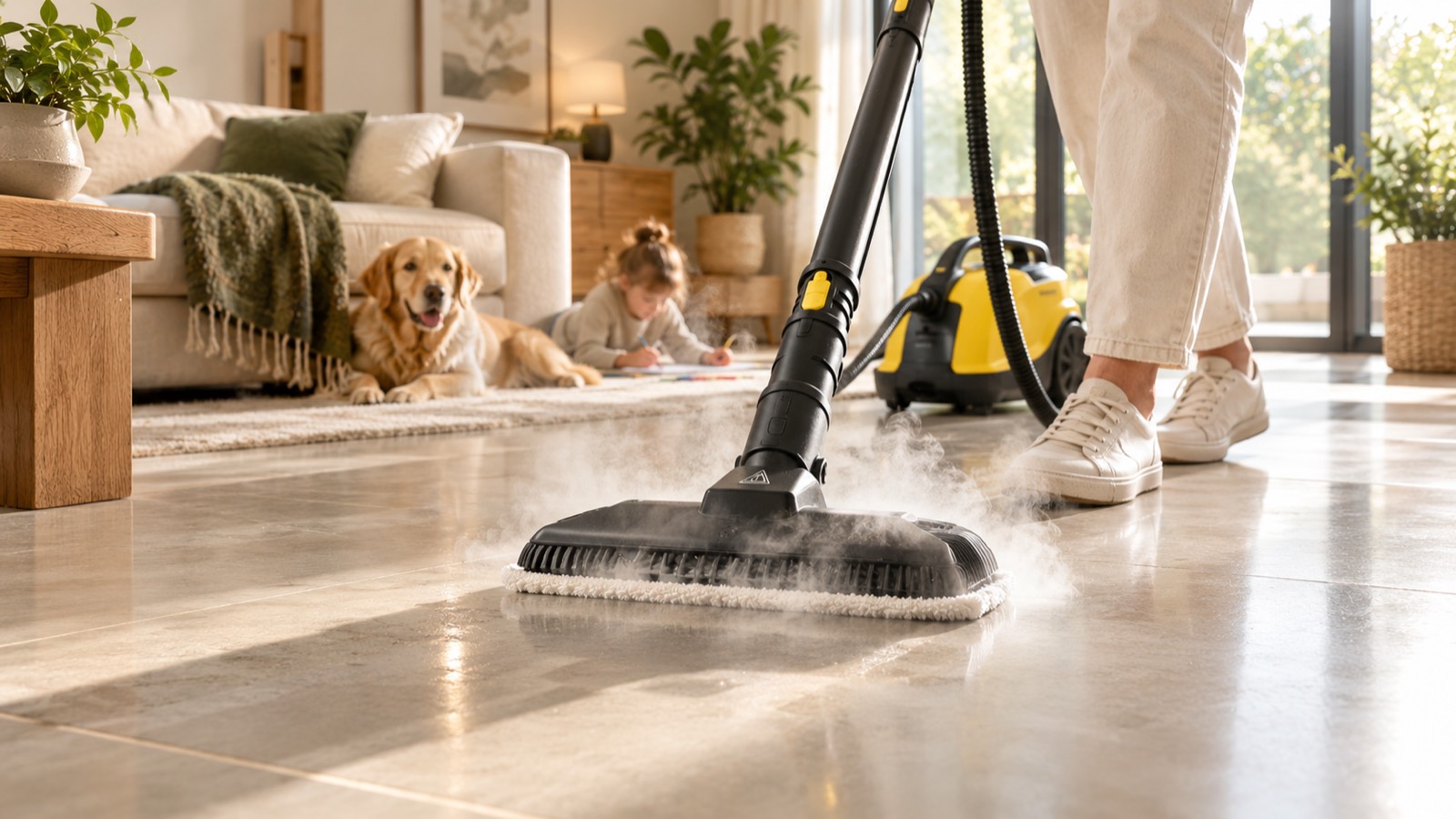
Steam cleaners have become increasingly popular in households across Europe. They promise chemical-free cleaning, using only the power of steam, but is it really better than conventional cleaning agents? The answer isn't black and white. Each method has its advantages and disadvantages, depending on the surface, the type of dirt and the situation in your home. In this article, we cover all the scenarios.
How does a steam cleaner work?
A steam cleaner heats water to 130-155°C and releases it at 3-4 bar pressure as a supersaturated steam. This steam:
- Mechanically breaks down dirt (heat softens fatty deposits)
- Kills bacteria, viruses and dust mites on contact (a temperature above 70°C eliminates 99.9% of microorganisms)
- Evaporates and dries quickly: no water left on the floor
- Leaves no chemical residues
Comparison: steam vs. chemical agents
| Criteria | Steam cleaner | Chemical agents |
|---|---|---|
| Disinfection | Excellent (99.9%) | Excellent (depending on the product) |
| Fat removal | Good (heat) | Excellent (detergents) |
| Stubborn stains | Medium | Excellent (specialist agents) |
| Environmental impact | Excellent (water only) | Poor to medium |
| Child safety | Excellent (no residue) | Medium (requires rinsing) |
| Pet safety | Excellent | Poor (many products are toxic) |
| Price per use | Minimal (water only) | Medium to high |
| Working speed | Slower | Faster for routine cleaning |
| Suitability for fabrics | Limited | Better (specialised solutions) |
Which surfaces is the steam cleaner better for?
Steam cleaner wins:
- Ceramic tiles and grout: steam penetrates porous grout and removes mould and bacteria that chemicals can't reach
- Kitchen worktop and grill: heat softens baked-on grease without a chemical degreaser
- Bathroom fittings and silicone: removes limescale and black mould without harsh acids
- Children's toys and surfaces: no chemical residues that could be toxic to children
- Car interior: disinfects seats, steering wheel, and door handles without chemicals
- Carpets and mattress (synthetic): kills dust mites and disinfects without wet cleaning
Chemical agents wins:
- Hard water-resistant calcium stains (white deposits): acidic acids dissolve them, steam does not
- Deep fabric stains: enzyme cleaners break down organic stains better than steam
- Toilet disinfection: active chlorine products stay in contact for longer and break down biofilm
- Kitchen chopping boards: antibacterial agents penetrate the wood, steam is less effective here
- White striped laundry: bleaches remove oxidation stains that steam does not
Safety: steam vs. chemicals for homes with children and pets
This is one of the most important differences.
Chemicals and children
Many household cleaners contain:
- Chlorine which irritates the respiratory tract
- Sodium hydroxide (lye) which burns skin and mucous membranes
- Quaternary ammonium: antimicrobial but toxic to pets
- Phthalates and perfumes which are endocrine disruptors
Children who crawl on the floor and put their hands in their mouths are particularly exposed to residual chemicals on surfaces. Even "eco-friendly" or "natural" products are not always safe.
Steam cleaners and children
Steam leaves no residue: the dry surface is completely safe immediately. The only danger is the steam itself, which can burn the skin, but this is eliminated with proper use (a machine with child safety locks).
The bottom line for families with children: Steam is safer for disinfecting toys, cots and floors. Chemicals remain necessary for stubborn stains and some specific problems.
An Environmental Perspective
The cleaning products we use at home every week end up in the sewers and, eventually, in nature.
| Aspect | Steam cleaner | Chemicals |
|---|---|---|
| Plastic packaging | No (just water) | Yes (multiple) |
| Chemical water pollution | None | Medium to high |
| CO₂ emissions | Low (electricity) | Medium (production + transport) |
| Toxicity to aquatic life | None | High (surfactants) |
How much does a steam cleaner cost?
Domestic steam cleaners are available from €60 to €400. More powerful models like the Kärcher SC 5 EasyFix start at around €300.
An alternative to buying is to hire the Kärcher SC 5 for a day, which is cost-effective for a thorough spring clean, moving house, or a one-off deep clean and sanitisation.
How to use a steam cleaner correctly?
- Use demineralised water (extends the life of the machine)
- Wait until the machine is fully heated before you start
- Start with a lower temperature and test on an inconspicuous area
- Use slower movements: allow the steam 5-10 seconds to work
- For grout and tiles, use the brush attachment to mechanically loosen the dirt
- Wipe with a microfibre cloth immediately after use.
- Do not use on waxed floors, lacquered surfaces, or silk fabrics
Local context: Dugo Selo and surroundings
For homes in Dugo Selo, Sesvete, Brckovljani, Vrbovec and Sveti Ivan Zelina, hire of the Kärcher SC 5 EasyFix steam cleaner with delivery is available. It also comes with a complete set of attachments for all surfaces, floors, tiles, barbecue grills, windows. One of the most popular combinations is the bundle (Puzzi + SC 5), which covers all surfaces in the home in a single day.
Frequently Asked Questions (FAQ)
Is steam safe for laminate flooring?
Generally not. Laminate is sensitive to moisture and heat, steam can cause the planks to swell and separate. Use a dry method or special laminate cleaners available to buy. If you do use steam, keep the temperature and contact time to a minimum.
Can a steam cleaner replace all chemical cleaners?
Not completely. Steam is excellent for disinfecting and removing grease, but it cannot dissolve mineral deposits (limescale) that require acid. For the toilet bowl, taps and shower cubicle, you will also need a suitable chemical cleaner in addition to steam.
How long does it take for a steam cleaner to heat up?
It depends on the model, usually 3 to 10 minutes. According to the manufacturer, the Kärcher SC 5 heats up in about 3 minutes. Some cheaper models also heat up quickly, but work at a lower pressure.
Can steam damage bathroom silicones?
High steam pressure can break down old and dried-out silicone over time, but for healthy silicone, short-term exposure is safe. Avoid prolonged direct contact between the machine and the silicone. Alternate steam treatment with a chemical disinfectant for silicone.
Is a steam cleaner good for cleaning windows?
Yes: especially with the rubber squeegee attachment. Steam loosens grease and dirt, and the squeegee pulls it all away. The result is streak-free and chemical-free. A good alternative to standard window cleaning products.
Can a steam cleaner replace toilet disinfection?
Steam kills 99.9% of bacteria and viruses on contact, comparable to chemical disinfectants. But in the toilet, the problem is the biofilm that accumulates in the S-bends and under the rim of the bowl, where steam cannot physically reach. A combination of steam + a toilet disinfectant (once a week) is optimal.
Can a steam cleaner be used on all types of flooring?
It is safe for: ceramic tiles, granite and marble floors, vinyl floors (brief exposure), linoleum. Not recommended for: laminate, waxed parquet, bamboo. On hardwood floors with a hard lacquer finish, brief exposure may be fine, but it is not ideal.
Does the steam cleaner use a lot of electricity?
The Kärcher SC 5 EasyFix has a heating output of 2,250 W. For comparison, an electric cooker uses 2,000-3,000 W, and an iron 2,000-2,400 W. The heater switches on and off during use, so one hour uses at most around 2.25 kWh of electricity, which is less than €0.50 at the average price. For a 3-4 hour deep clean, this comes to about €2 at most, negligible compared to the cost of chemical products.
Can a mattress be cleaned with steam?
Yes, steam is good for freshening up and sanitising the mattress surface. Go over it slowly without lingering on one spot, and let the mattress dry completely before putting the bedding back on. Steam does not pull stains and dirt out from deep inside, for that you need extraction washing.
Do I need any cleaning product with a steam cleaner?
For most jobs, no, water is enough. On very greasy surfaces, such as a cooker hood or an oven, it helps to apply a little degreaser before steaming. Never put cleaning products or fragrances in the steam cleaner's tank, only water.
Conclusion
A steam cleaner isn't a replacement for everything, but it is for a lot. For a home with children and pets, especially for disinfecting and cleaning hard surfaces, steam is an excellent alternative to chemicals. For fabric stains, limescale, and specific chemical issues, specialised products are still necessary. It's wise to have both and to know when to use each.
If you don't have the right equipment or simply don't feel like doing it yourself, get in touch. We can come and do the cleaning for you, or you can hire Kärcher machines and do it yourself.