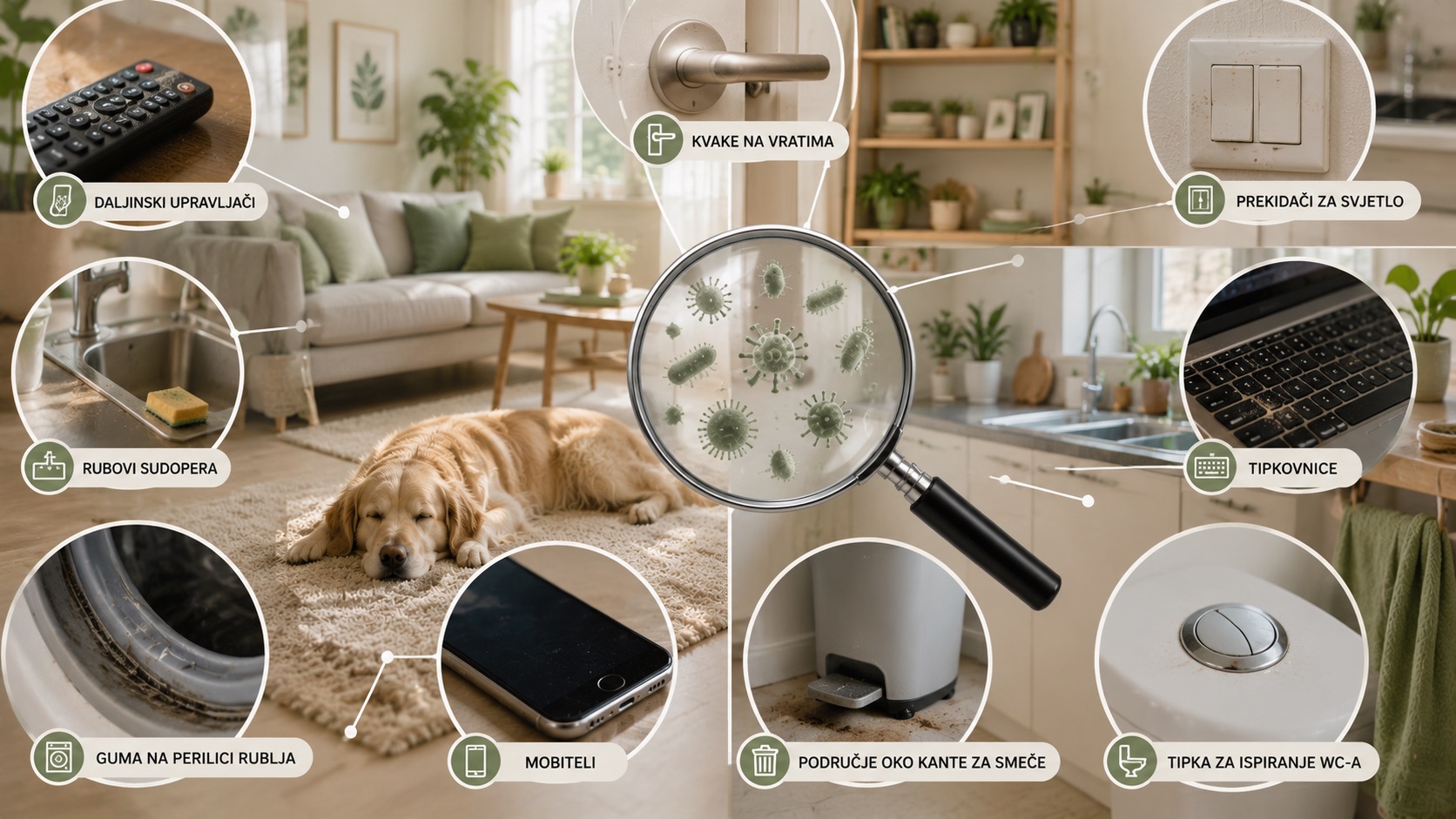
The places that look dirty are rarely the most microbiologically hazardous. Microbiologists who have measured bacteria in households reached the opposite of what we would expect: the remote control, the light switch and the kitchen tap, which look clean, often harbour more bacteria than the toilet seat we all diligently clean. This guide gets to every nook and cranny that's usually skipped.
Research says the opposite of what our intuition tells us
Measurements of bacteria on items in an average household gave roughly this picture:
| Item | How many bacteria | Gut bacteria (e.g. E. coli) |
|---|---|---|
| Dish sponge | Very many | Often |
| Chopping board | Many | Often |
| Kitchen tap handle | Many | Often |
| Fridge vegetable drawer | Many | Sometimes |
| Fridge rubber seal | Moderate | Sometimes |
| Remote control | Moderate | Sometimes |
| Light switch | Moderate | Sometimes |
| Toilet seat | Few | Rarely |
Conclusion: the toilet seat is regularly cleaned with strong cleaning agents, and the chopping board used for raw meat is washed with lukewarm water.
Top spots most often forgotten
1. Dish sponge
The most dangerous item in the household. Moist, warm, full of organic material, ideal for bacterial growth. A sponge used for a week is full of bacteria. Disinfection methods:
- Microwave: wet sponge for 2 minutes on high power (kills 99% of bacteria)
- Boiling for 5 minutes
- Replace every 1-2 weeks (the cheapest solution)
- Alternative: silicone dish brush that dries between uses
2. Cutting board
Plastic boards in particular: micro-scratches harbour bacteria that washing cannot remove. Methods:
- Separate boards for meat, vegetables, and bread (colour-coded system)
- Wooden boards: disinfect with salt and lemon (abrasion + acidity)
- Plastic boards: dishwasher on a 65°C+ programme
- Replace plastic boards annually if deep scratches are visible
3. Light switches and door handles
Everyone touches them, every day, with hands that aren't always clean. And how often do you clean them? Method:
- Damp microfibre cloth + a drop of antibacterial cleaner
- Rubbing alcohol on a cloth (do not spray directly, electrical safety)
- Frequency: once a week; during flu season, every day
4. Remote controls
Everyone uses them, with hands covered in food, snot, everything. Dust, grease and bacteria collect between the buttons. Method:
- Remove the batteries
- Use compressed air to blow out any debris from between the keys
- Carefully wipe each button with a cotton bud soaked in alcohol (70% isopropanol)
- A cotton bud for the spaces between the buttons
- Frequency: once a week
5. Computer keyboard and mouse
Keyboards often harbour more bacteria than a toilet seat. Method:
- Turn it upside down and tap it to dislodge any crumbs
- Compressed air between the keys
- 70% alcohol on a microfibre cloth for surfaces
- Q-tip between the keys
- Frequency: once a week
6. Phone (mobile)
You take your phone to the toilet, into the kitchen, and eat with it. A phone often carries more bacteria than a toilet seat. Method:
- Microfibre cloth for the screen (dry, without any cleaning agents)
- 70% alcohol on the edge of the cloth for the edges and back (not the unprotected screen)
- UV disinfection boxes for phones: they exist and work
- Frequency: quick wipe daily, more thorough wipe once a week
7. Kitchen tap (handle)
With hands covered in raw meat, dirty dishes, and you immediately touch the tap. Contamination is almost certain. Method:
- A damp cloth with an antibacterial agent every day
- Pay special attention to the handle and the base of the tap
- Disinfect once a week
8. The fridge's rubber seal
The folds of the rubber seal collect moisture, food crumbs and mould. Detailed in the guide How to Clean Your Fridge. In short: an old toothbrush + bicarbonate of soda paste, once a month.
9. Drains
Drains in the kitchen and bathroom are full of bacteria. Method:
- Weekly: Boiling water + a drop of washing-up liquid down the drain
- Monthly: bicarbonate of soda + vinegar → 15 mins + boiling water (cleans and deodorises)
- Drain strainer: dishbrush + antibacterial agent
10. Under furniture
Under the sofa, bed, wardrobe, dust, pet hair, dust mites, and sometimes food. Especially problematic for allergy sufferers. A vacuum cleaner with a long attachment once a week, or more often if you have shedding pets. More on dust mites in mattresses: Dust mites in mattresses: how to remove them.
11. Fabric or plastic shower curtain
Damp, warm, organic, ideal for mould and bacteria. Method:
- Plastic: dishwasher on a cold cycle, dry stretched out
- Fabric: a 60°C wash in the washing machine with a little vinegar
- Frequency: once a week or twice a month
12. Toilet seat button
The toilet flush lever isn't the most dangerous (everyone knows how to clean it), but the toilet roll holder and bathroom shelves are often forgotten. Once a week, wipe all metal parts in the bathroom with an antibacterial cloth.
Checklist: forgotten places
- ☐ Dish sponge: disinfect or replace
- ☐ Chopping board: disinfect with salt and lemon or in the dishwasher
- ☐ Light switches and door handles, wipe with alcohol
- ☐ Remote control: alcohol + cotton bud
- ☐ Keyboard and mouse: compressed air + alcohol
- ☐ Mobile phone: microfibre + alcohol edges
- ☐ Kitchen tap handle: antibacterial agent
- ☐ Fridge seal: bicarbonate of soda + toothbrush
- ☐ Drains: bicarbonate of soda + vinegar + boiling water
- ☐ Under furniture: vacuum cleaner
- ☐ Shower curtain: wash
Local context
Spring and autumn deep cleaning of homes in Dugo Selo, Sesvete, Brckovljani and the surrounding area is the ideal opportunity to systematically inspect all these forgotten zones. Alongside the general cleaning, it is recommended to include disinfection of all contact surfaces and a deep clean of the areas under and behind furniture.
Frequently Asked Questions (FAQ)
Is the toilet seat really cleaner than kitchen surfaces?
According to microbiological research: yes. The toilet seat is regularly cleaned with strong disinfectants, whereas kitchen surfaces are cleaned with mild detergents. Furthermore, bacteria from the toilet are generally harmless to humans (E. coli in the gut is normal flora), whereas bacteria from raw meat (Salmonella, Campylobacter) can cause serious illnesses. Context is important, but both areas should be cleaned regularly.
How long does a disinfectant need to remain on a surface to kill bacteria?
Most disinfectants require a "contact time" of 30 seconds to 2 minutes for 99.9% elimination of bacteria. A quick wipe and immediate drying is not disinfection, it's just cleaning. You apply the product, wait the specified contact time (on the label), THEN wipe it off. This applies to alcohol, bleach and commercial disinfectants.
Can a dish sponge really be disinfected in the microwave?
Yes. Two minutes in the microwave kills a large share of the bacteria in a wet sponge. IMPORTANT: the sponge must be wet (a dry sponge in the microwave can catch fire). This method doesn't extend the sponge's life indefinitely, replacing it every 1-2 weeks is still recommended, regardless of disinfection.
What are the most dangerous pathogens in the home?
Salmonella (raw meat and eggs), Campylobacter (chicken), E.coli O157:H7 (raw meat, vegetables), Listeria (cold meat products, dairy), Norovirus (contact surfaces, food). All of these are most commonly found in the kitchen, not the bathroom. Regularly disinfecting kitchen contact surfaces (chopping board, tap, sponge) is the most important preventative measure.
Should you use antibacterial soap, or is regular soap sufficient?
For everyday hand washing, antibacterial soap is not significantly more effective than ordinary soap. Washing with ordinary soap for 20 seconds mechanically removes bacteria from your hands just as effectively. Antibacterial products (sprays, wipes) are useful on contact surfaces (not on hands) because they remain on the surface for longer.
How often should pillowcases be changed for hygiene?
Once a week. A pillowcase collects dead skin cells, sweat, saliva and cosmetic residue, an ideal breeding ground for dust mites and bacteria. For people with skin problems, acne or allergies, every 3-4 days. Washing at 60°C kills dust mites and sterilises. More about dust mites: Dust mites in mattresses.
What is the most effective method for disinfecting contact surfaces?
70% alcohol (isopropyl or ethanol) is the most effective for quickly disinfecting hard surfaces, effective against bacteria, viruses and fungi. Wet wipes with quaternary ammonium (Dettol, Lysol) are an alternative for larger surfaces. For kitchen surfaces with food, avoid chlorine; use a dedicated kitchen disinfectant or an evaporative alcohol.
Should you disinfect mobile phones and remote controls when someone in the household is ill?
Absolutely. With flu, norovirus or any infectious illness in the household, disinfecting all touch surfaces (mobile, remote, keyboard, handles) once a day minimises transmission. 70% alcohol on cotton wool or disinfectant wipes. Don't forget the taps in the bathroom and kitchen, too.
How often should a keyboard and mouse be cleaned?
At least once a week, and more often if you eat at the computer or several people use it. Unplug the keyboard, turn it over and gently shake out the crumbs, then wipe the keys and mouse with a cloth lightly dampened with alcohol or a disinfecting wipe. No liquid should drip between the keys.
Should door handles and light switches be disinfected?
For regular cleaning, wiping them once a week with a cloth and a little detergent is enough. When someone at home is ill, wipe door handles, switches, taps and remote controls every day with a disinfectant and leave it on for as long as the label says.
Conclusion
The most dangerous bacteria in your home aren't where you think they are. The kitchen, not the bathroom, is the microbial centre of gravity. Fifteen minutes a week on touchpoints, taps, switches, chopping boards, sponges, remotes, dramatically reduces the risk of illness in the home.
If you don't have the right equipment or simply don't feel like doing it yourself, get in touch. We can come and do the cleaning for you, or you can hire Kärcher machines and do it yourself.