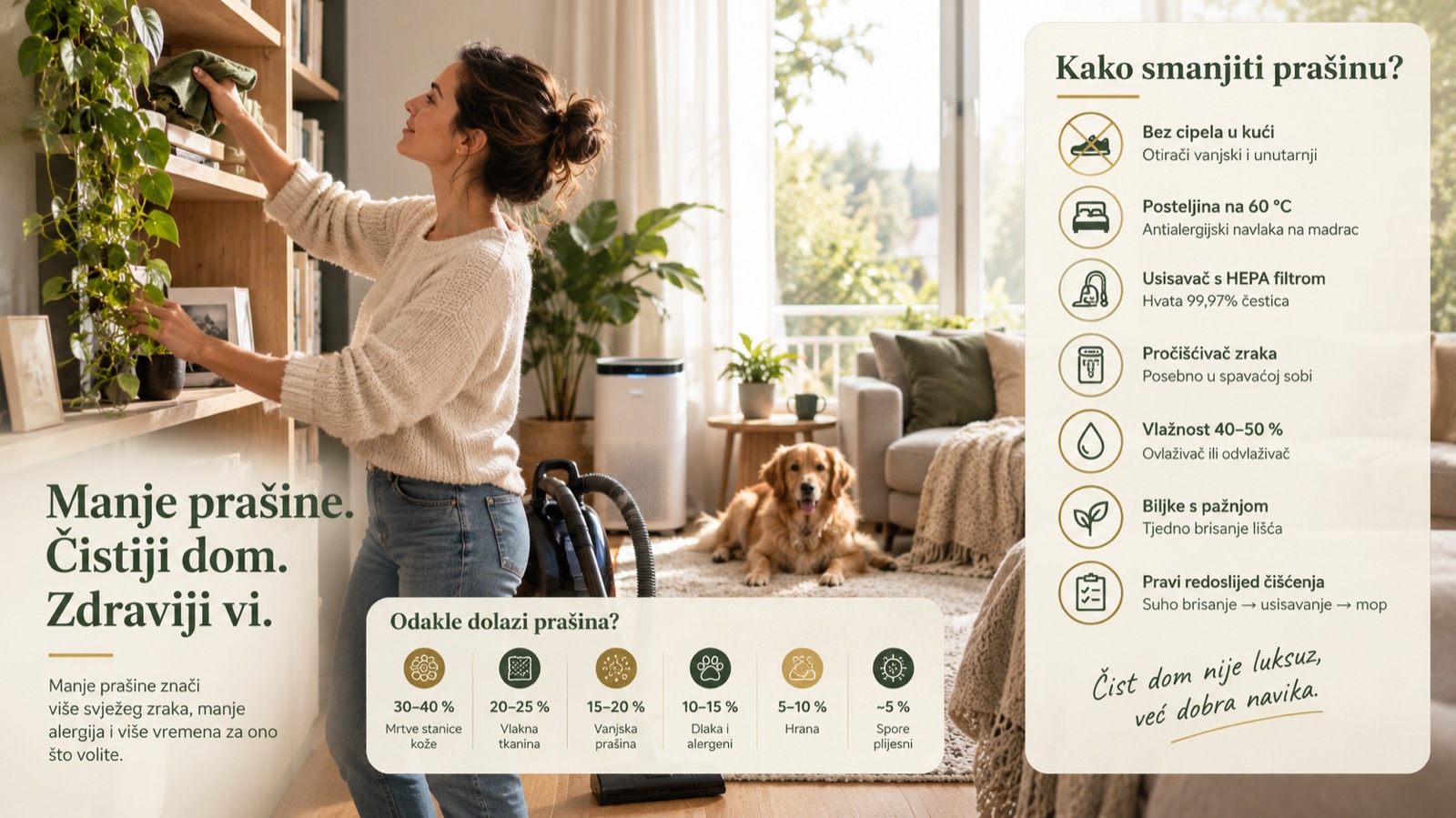
Clean the shelf of dust today, and tomorrow it's back again. Dust is the household's Sisyphus task, inescapable, eternal, tedious. But its amount isn't the same in every home, and it's no accident. Homes that manage dust smartly have less cleaning to do, cleaner air and a lower risk of allergies. Here's where dust comes from, what keeps it in the air and how to dramatically reduce its presence.
Where does household dust come from?
House dust isn't just 'dirty soil', it's a complex mixture of particles from both indoor and outdoor environments:
| Source | Share | What brings it |
|---|---|---|
| Dead skin cells | ~30-40% | Food for dust mites |
| Fabric fibres (clothing, carpet, upholstery) | ~20-25% | Microfibres, synthetics |
| Outdoor dust (brought in on footwear, in the air) | ~15-20% | Dirt, pollen, pollutants |
| Pet hair and allergen | ~10-15% | Allergenic proteins |
| Food (crumbs, flour dust) | ~5-10% | Food for bacteria and insects |
| Mould spores | ~5% | Allergens, potentially toxic |
Why does dust come back so quickly?
Dust in the air settles on surfaces, and any movement (walking, sitting down, wind through the window) lifts it up again. Without a strategy, the cycle is endless. The solution is:
- Reduce dust sources
- Trap dust (filters) instead of moving it around
- Correct cleaning order (from top to bottom)
Reducing dust sources
Footwear: external dust ingress
Much of the dirt in a home is carried in on footwear. Solution:
- No shoes in the house
- Two mats: an outdoor one (abrasive, to scrape off mud) and an indoor one (to absorb moisture)
- Regularly clean the mats (vacuum once a week)
Bed linen and pillowcases
Bed linen is one of the biggest generators of dead skin cells and a habitat for dust mites. Dust mites in the mattress are directly linked to dust and allergies. Measures:
- Wash bedding at 60°C once a week
- Hypoallergenic mattress and pillow covers
- Regularly ventilate the room (dust mites do not like dry, fresh air)
Carpets and furniture covers
Carpets collect and hold dust, pet hair and dust mites. It's useful to know: a smooth floor (wood, ceramic) is easier to clean than a carpet, but dust tends to become airborne more as there is no absorption. Carpets collect dust, but they require regular, deep vacuuming. Deep-cleaning the carpets once or twice a year eliminates accumulated allergens.
HEPA filters: trap dust, not move it
A HEPA (High Efficiency Particulate Air) filter captures 99.97% of particles 0.3 microns and larger. Where to use it:
Vacuum cleaner with a HEPA filter
A vacuum cleaner without a HEPA filter releases fine dust back into the air through the exhaust filter. A HEPA vacuum cleaner traps it. Essential for allergy and asthma sufferers. Replace the HEPA filter according to the manufacturer's recommendation (usually annually).
Air purifier with a HEPA filter
For the rooms where you spend the most time (bedroom, living room). A purifier with a HEPA + carbon filter eliminates dust, allergens, mould spores and odours. A good home purifier costs from about €70 to €270 or more.
Air conditioning with a filter
An air conditioning unit that is not serviced regularly (filters clogged with dust) spreads dust and germs throughout the room. Clean the air conditioning unit's filter every 2-4 weeks during the season of use.
The correct cleaning order
This is the most common mistake that causes dust to "hang" in the air for hours after cleaning:
- First: dry wipe: with an antistatic cloth or microfibre (captures, not lifts dust)
- Immediately: vacuuming: before the dust falls to the floor
- Finally: mopping the floor: a damp mop traps any remaining dust in the wet cloth.
Do not use dry brooms to sweep smooth floors, they just kick dust up into the air.
Air humidity and dust
Relative humidity affects dust in two ways:
- Too low humidity (<30%): dust stays in the air for longer, dry mucous membranes = reduced natural defences
- Too high humidity (>60%): dust mites and mould, increased allergen content
- Optimum: 40-50%: dust falls faster, dust mites less active
Humidifier (in winter) and dehumidifier (in summer) for humidity control.
Houseplants and dust
Plants filter the air (NASA Clean Air Study), but they also collect dust on their leaves. Compromise:
- Wipe leaves weekly with a damp cloth
- Top air-filtering plants: Pothos, Peace Lily, Spider Plant, Sansevieria
- Don't overcrowd, too many plants in a small room increases humidity
Local context
Households in Dugo Selo, Sesvete, Vrbovec and the surrounding area that are closer to busy roads or industrial zones bring in more outdoor dust and pollutants. A combination of a HEPA vacuum cleaner, regular deep cleaning of furniture and carpets (including deep cleaning the sofa) and seasonal airing with filters yields visible results.
Checklist: reducing dust
- ☐ No shoes in the house
- ☐ Doormats: outdoor and indoor
- ☐ Wash bedding at 60°C weekly
- ☐ Anti-allergy mattress cover
- ☐ Vacuum cleaner with a HEPA filter
- ☐ Bedroom air purifier
- ☐ Air conditioning filter: cleaned every 3-4 weeks
- ☐ Order: dry dusting → vacuuming → damp mopping
- ☐ Humidity 40-50%
- ☐ Minimise dust-trapping textiles
Frequently Asked Questions (FAQ)
Why does dust return so quickly, even after a thorough clean?
Because dust sources (skin cells, fabric, fibres, external ingress) are constantly being generated. Cleaning removes the accumulated dust, but it doesn't stop the production of new particles. A source reduction strategy (footwear, bedding, HEPA filters) is the only way to slow the rate of accumulation. Realistically, the goal isn't zero dust, that's impossible, but rather controlled, slow accumulation.
Is there more dust in an old or a new house?
It depends. Older houses have more cracks that let in outdoor dust and often more fabrics and carpets that accumulate it. Newer houses are better insulated, but the materials used in their construction release fine particles (VOCs, mineral wool) for over a year. In both cases, HEPA filtration and regular cleaning are equally necessary.
Can houseplants really purify the air of dust?
Partially. A NASA study showed that some plants filter specific chemicals (formaldehyde, benzene, xylene) from the air. But for a visible effect on dust, you need about one plant per 10 m², which is practically unrealistic in a normal flat. Plants are useful, but a HEPA air purifier is far more effective against dust.
Is dust dangerous to your health?
Fine dust particles (PM2.5, less than 2.5 microns) penetrate deep into the lungs and can cause inflammation, worsen asthma and lead to cardiovascular problems with long-term exposure. Dust mites are the main cause of house dust allergies (affecting 20-30% of the population). Mould spores in dust can cause allergies and infections. For sensitive individuals, HEPA filtration is not a luxury, it is a medical necessity.
Should you ventilate the room when it's dusty outside (during pollen season)?
During high pollen counts (spring, especially April-June), a short morning airing (5-10 mins, early in the morning when pollen concentration is lower) is a compromise. An air purifier with a HEPA filter, with the windows closed, is the optimal solution for allergy sufferers during the pollen season.
What is the most common cause of increased dust in a flat?
In city flats: outdoor dust brought in on shoes and through windows. In houses with carpets, carpet fibres and pets. In older properties, cracks in the walls and floors through which dust enters. The answer varies, but footwear and bedding are almost always in the top three sources.
How often should an air purifier be cleaned?
Pre-filter: vacuum or rinse weekly (if washable). HEPA filter: replace every 6-12 months depending on use (as indicated by the device). Carbon filter: replace every 3-6 months. Regular filter replacement is critical, a clogged filter not only fails to filter but can also re-release accumulated particles.
Are microfibres from synthetic clothing a problem for dust?
Yes, and it is an increasing environmental and health problem. Every wash of synthetic clothing (polyester, nylon, acrylic) in the washing machine releases microplastic fibres which end up in the air and the home. Washing machine filters (Guppyfriend bags, Cora Balls) catch some of these particles. This is another reason to prefer natural fabrics (wool, cotton, linen) for home textiles.
Is it better to dust with a dry or a damp cloth?
A lightly damp microfibre cloth, because it picks up the dust and holds on to it, while a dry cloth mostly just stirs it into the air. On electronics, wood and delicate surfaces, use a dry microfibre cloth, which also traps dust well because of its structure.
In what order should I dust a room?
From top to bottom: first the light fittings, the tops of wardrobes and the shelves, then tables and furniture, and vacuum the floor last. That way the dust that falls from higher surfaces ends up on the floor and you vacuum it up with the rest.
Conclusion
Zero dust in the home isn't a realistic goal, but a dramatic reduction is very much possible. A no-shoes rule, a HEPA vacuum cleaner, weekly linen changes and humidity control, these four habits noticeably reduce dust and improve the air you breathe.
If you don't have the right equipment or simply don't feel like doing it yourself, get in touch. We can come and do the cleaning for you, or you can hire Kärcher machines and do it yourself.