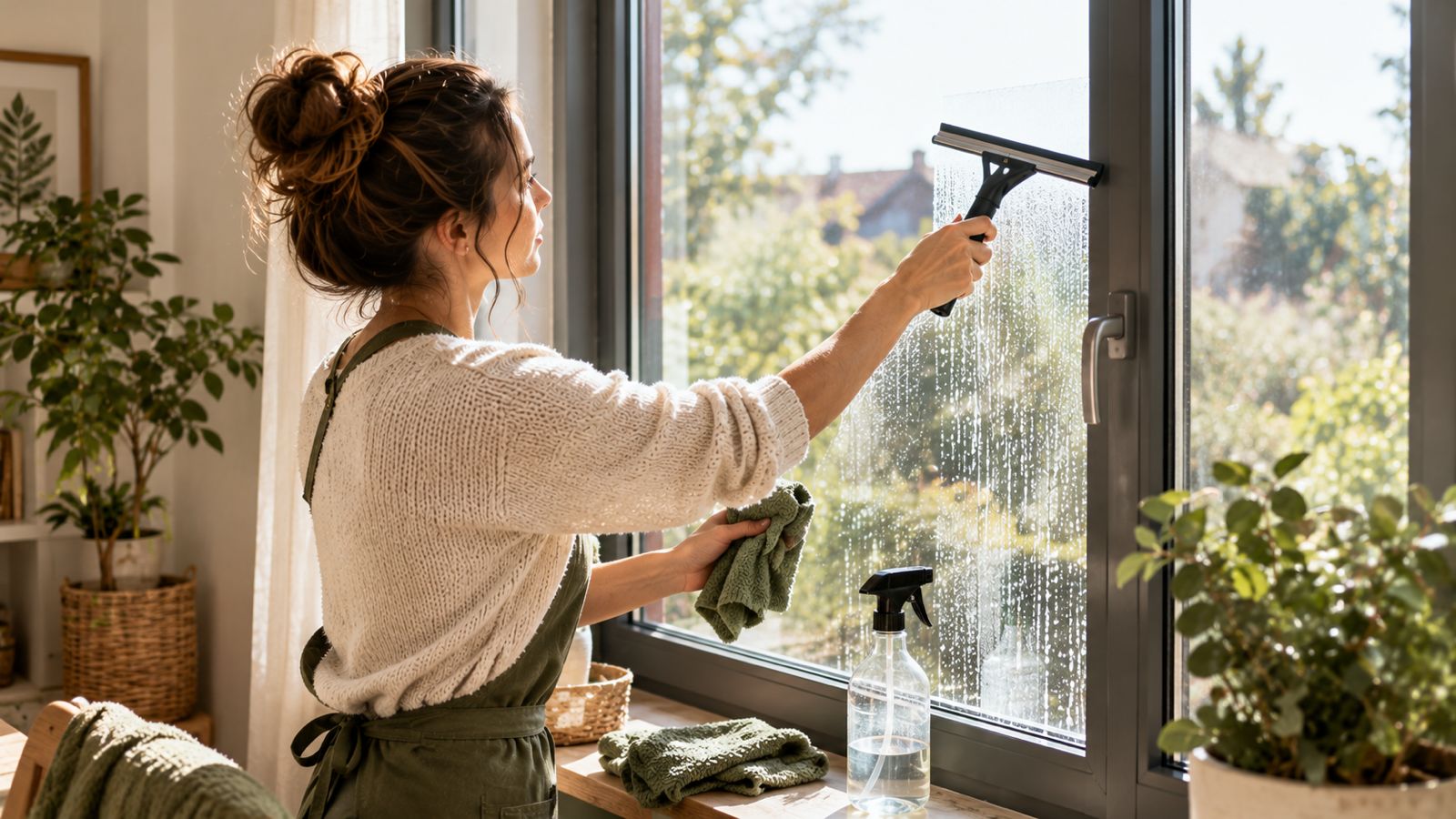
Streak-free windows look simple: until you try. A paper towel and window cleaner? Streaks. Old newspaper and vinegar? Better, but still stains in the corners. And the sunlight shining on the windows immediately after cleaning reveals everything you've missed. Streak-free window cleaning is a combination of the right tools, the right product, the right timing and, above all, the correct wiping technique.
Why do windows get streaks?
Streaks occur for several reasons:
- Mineral deposits from the water (lime, magnesium) that are left behind as the water evaporates
- Residue from cleaning products that are too soapy or are not rinsed off thoroughly
- A dirty cloth that spreads dirt instead of picking it up
- Incorrect technique (circular motions = streaks, linear motions = no streaks)
- Sun: cleaning in direct sunlight dries the solution too quickly and leaves streaks
Tools that make a difference
Rubber blade: window squeegee
The only tool that guarantees streak-free windows. The rubber blade wipes away water in a single pass, leaving no streaks. Use:
- Medium size (30-35 cm) for standard windows
- Replace the blade annually (or as soon as it starts to leave streaks)
- Technique: top to bottom, one long stroke, wipe the blade with a dry cloth between passes.
Microfibre cloth: for details
Microfibre collects dirt and water particles without leaving any fibres behind. Never use paper towels (they leave fibres) or old cotton cloths (they spread dust).
Newspaper (classic method)
Newspaper has a special density and ink that helps to wipe the glass streak-free. Only for clean windows, not for heavily soiled ones.
The right product for windows
| Product | Efficiency | Streaks | Price |
|---|---|---|---|
| Vinegar + distilled water (1:3) | Excellent | None | Minimal |
| Commercial window cleaner | Excellent | Minimal | Medium |
| Washing-up liquid + water (1 drop) | Good | Possible (too much soap) | Minimum |
| Clean distilled water | Good | None | Low |
| Ordinary tap water | Weak | High (limescale) | None |
Recommendation: Vinegar diluted with distilled water (1:3) is the most effective, cheapest and most environmentally friendly combination. Vinegar dissolves limescale and grease, while distilled water leaves no mineral deposits.
Step-by-step: streak-free window cleaning
- Choose a cloudy day or a shady spot: direct sunlight dries the solution too quickly
- Wipe the frames with a damp cloth: dust from the frames will fall onto the clean glass
- Apply the solution with a spray bottle or a damp microfibre cloth (well saturate the glass)
- Wipe heavily soiled areas (insect marks, limescale) in a circular motion with a cloth to soften them
- Wipe with a squeegee from top to bottom, one horizontal stroke
- Wipe the rubber blade with a dry cloth between each pass
- Finish the corners and edges with a dry microfibre cloth
Steam window cleaner (SC5)
The Kärcher SC5 with the window tool (triangular nozzle + squeegee) can deliver excellent results:
- Steam loosens dirt and limescale from exterior windows
- The rubber squeegee (squeegee attachment) immediately collects the moisture
- Useful for hard-to-reach windows (height, corners) where a handheld squeegee can't reach
- Recommended: steam, then immediately wipe with a microfibre cloth and the squeegee.
Inside vs. outside of the window
Internal side
Generally dirtier with grease, condensation and dust. More easily accessible. Clean more often (monthly).
External side
Dirt, rain, insects, bird droppings, blossom. Seasonal (spring and autumn). Use a telescopic squeegee handle for high windows without standing on chairs.
Winter windows: condensation
Condensation on the inside of the window (winter period) is a sign of high relative humidity in the room. This is not a window problem but an issue with the air humidity. Solutions:
- Ventilate rooms for 15-20 minutes in the morning
- Dehumidifier in rooms with high humidity
- Check the window seals (for draughts)
Local context
Spring cleaning of windows is an integral part of a general home clean in all households in Dugo Selo, Sesvete, Brckovljani, Vrbovec and Sveti Ivan Zelina. Window and complete exterior cleaning services are particularly popular. Hiring a Kärcher SC5 for seasonal cleaning of windows, floors and bathrooms is a cost-effective solution that delivers professional results.
Window Cleaning Checklist
- ☐ Overcast sky or shade: not direct sunlight
- ☐ Clean window frames: frames first, then the glass
- ☐ Sprayer with vinegar + distilled water
- ☐ Squeegee with a clean rubber blade
- ☐ Clean microfibre cloths: separate for wet and dry
- ☐ Top-down technique
- ☐ Wipe blade between passes
- ☐ Corners and edges: final microfibre
Frequently Asked Questions (FAQ)
Why do windows have streaks and marks after cleaning?
The most common causes are: a dirty cloth (spreading dust), too much soap or cleaning solution, cleaning in the sun (quick drying), and hard water. The solution: vinegar + distilled water, a squeegee with a clean blade, overcast skies or shade, a clean microfibre cloth.
Can vinegar be used on tinted (foiled) windows?
Diluted vinegar (1:3 with water) is safe for the exterior of tinted glass. On films (privacy film), avoid vinegar as the acid can degrade the film and adhesive. Use a neutral glass cleaner or just distilled water with a microfibre cloth.
How often should windows be cleaned?
Inside: once a month or as needed (kitchen grease, dust). Outside: at least in spring and autumn; more frequently in coastal or busy areas. Winter condensation on the glass, wipe with a dry microfibre as soon as it appears to prevent damage to the frame.
Can limescale on windows be permanently removed?
Limescale (calcium deposits) can be removed with vinegar, citric acid, or commercial anti-scale products. But it returns every time rain or condensation leave minerals behind. Prevention: use deionised water for washing, a glass impregnator (nano-coating) that repels water and prevents deposits.
Can a steam cleaner damage window glass?
When used correctly, no. Steam doesn't damage the glass, but thermal shock can be a problem if the glass is cold (e.g. in winter). Never use steam on a frozen window. At normal temperatures, the SC5 with the window tool gives excellent results without causing damage.
How to clean upper-floor windows safely?
A telescopic squeegee handle extends your reach to 3-4 metres without having to stand on a ladder. For more, a magnetic window cleaner (two parts, an inner and outer one that move via magnets) is a safe option for windows that don't open. Absolutely no standing on ladders or other unstable surfaces.
What is a nano-coating for glass and is it worth it?
Nano-coatings (Rain-X etc.) create a hydrophobic layer on the glass that repels water in beads that roll off by themselves. On windows: fewer rain streaks, less limescale. It's applied once a year. Especially useful on vehicles. On household windows, useful for reducing the frequency of cleaning the exterior panes.
What is the difference between a typical household window cleaner and a professional one?
Home products (Sidolin, Windex) are formulated for the casual user, they dry quickly and are less concentrated. Professional products (Koch Chemie, Sonax) are concentrated (diluted), odourless, and optimised for the squeegee technique. For household use, diluted vinegar is just as effective as professional products for standardly dirty windows.
How do I clean window frames and sills?
First vacuum the dust and insects out of the grooves and corners, then wipe the frames with warm water and a little detergent. Do not use abrasive cleaners or solvents on PVC, as they dull the surface. Wipe wooden frames with a barely damp cloth only and dry them straight away.
Is it better to wash windows on a sunny or a cloudy day?
On a cloudy day. In strong sun the cleaner dries before you can wipe it off and leaves streaks. If you wash them on a sunny day, choose the morning or late afternoon, when the sun is not shining directly on the glass.
Conclusion
Streak-free windows aren't a myth, it's a combination of the squeegee technique, distilled water with vinegar, and a cloudy sky. Once you've mastered the right technique, cleaning the windows of a whole flat can be done in under an hour, with a brilliant result that lasts.
If you don't have the right equipment or simply don't feel like doing it yourself, get in touch. We can come and do the cleaning for you, or you can hire Kärcher machines and do it yourself.