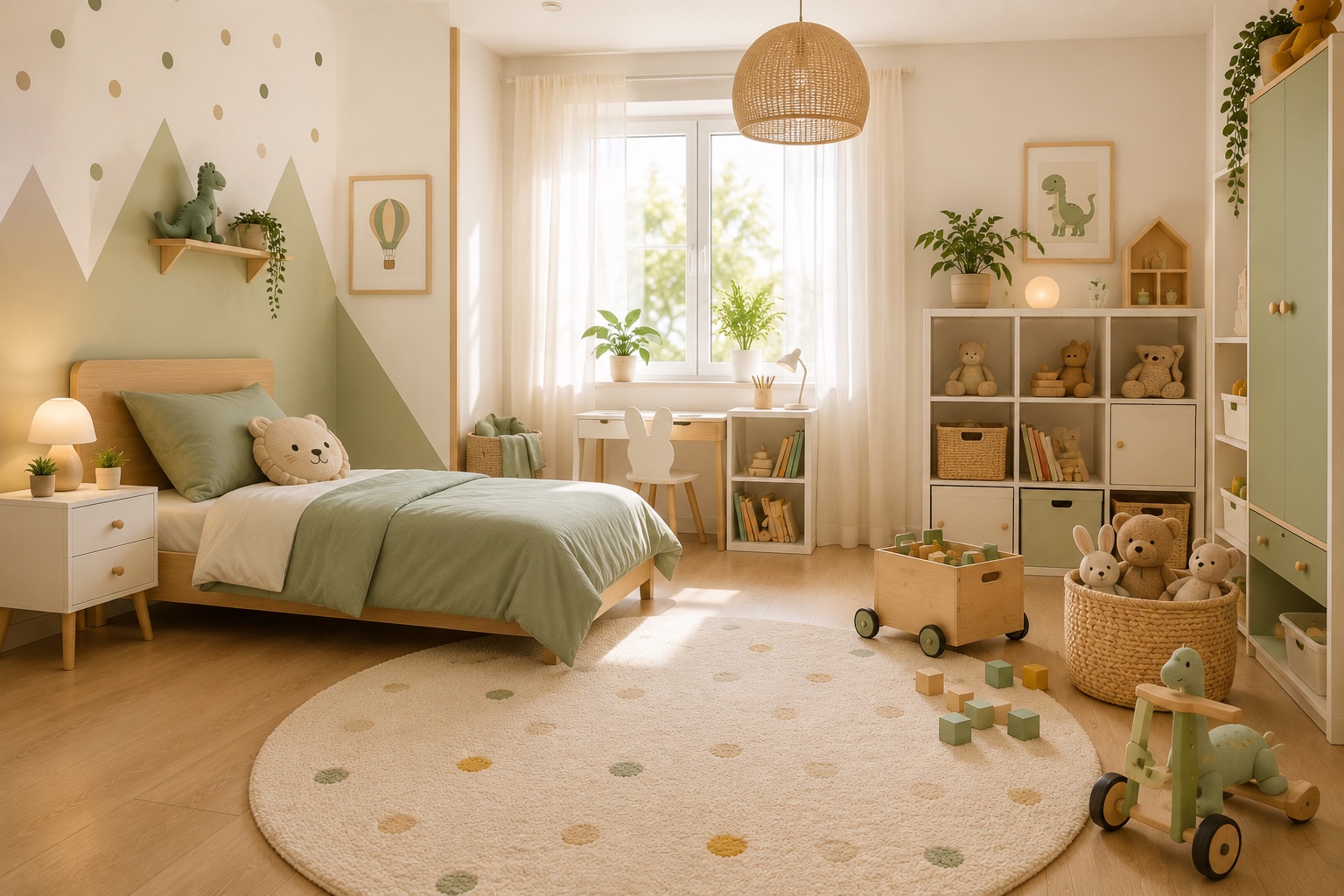
Children spend up to 12 hours a day in their room, sleeping, playing, eating snacks, drawing on the floor. At the same time, their immune system is still developing and is more sensitive to chemicals, allergens and pathogens than an adult's. That's why cleaning a child's room is a category of its own, the usual "the stronger, the better" rule doesn't apply. This guide goes through every area of a child's room with methods that are effective and completely safe for children.
Why is a child's room a special case?
- Children spend more time close to the floor, they breathe in more of the dust and chemicals that settle near the floor
- They put their hands and objects in their mouths, contamination on toys is passed on directly
- Their immune system is still developing, sensitivity to chemicals is higher
- They are more exposed to dust mites (mattress, carpet, pillow), the leading trigger of allergies and asthma in children
Products best avoided in a child's room
| Product | Problem | Alternative |
|---|---|---|
| Chlorine (bleach) | Irritates the lungs, eyes and skin | 3% hydrogen peroxide |
| Ammonia (glass cleaners) | Toxic when inhaled | Vinegar + distilled water |
| Synthetic fragrances (air fresheners) | VOCs, allergens | Airing the room |
| Antibacterial soaps (triclosan) | Hormone disruptor | Ordinary soap + rinsing |
| Chemical degreasers | Irritants | Bicarbonate of soda + vinegar |
The floor: the most important area
Children live on the floor. The floor of a child's room is the area with the highest hygiene priority.
Carpet in a child's room
A carpet collects dust mites, dust, hair, crumbs and bacteria. Recommended routine:
- Vacuuming with a HEPA filter: every day or every other day
- Vacuuming with a brush head for deeper cleaning of the fibres: weekly
- Deep cleaning (Kärcher Puzzi 10/1): every 3-4 months, hot water + extraction eliminates dust mites and bacteria
- Dry completely: a damp carpet is a breeding ground for mould
More about deep cleaning carpets: How dirty is your carpet really?
Laminate or parquet
Easier to clean than carpet, but it keeps dust in the air:
- Robot vacuum: every day
- Damp microfibre cloth with clean water: 2-3 times a week
- For disinfection: diluted vinegar (1:5 with water) or, on ceramic tiles, the SC5 steam cleaner
The mattress in a child's room
Dust mites in children's mattresses are one of the leading causes of asthma and allergies in children. Children sweat more than adults, so the mattress is damp and warm, a perfect environment for dust mites.
- A protective cover (anti-allergy cover for the mattress and pillows), a must in a child's room
- Bedding washed at 60°C every week: kills dust mites and their allergens
- Deep cleaning the mattress every 3-6 months: Puzzi 10/1 + anti-dust-mite treatment
- Air the room every morning for 15 minutes: dust mites don't like fresh, dry air
More about dust mites in mattresses: Dust mites in your mattress: everything you need to know.
Toys: disinfection without chemicals
Plastic toys
- Hard plastic toys: dishwasher at 60°C (without the drying cycle), or soak in a mixture of water and white vinegar for 30 minutes
- Smaller toys: in a bag in the freezer at -18°C for 48 hours, kills dust mites and some bacteria
- Electronic toys: 70% alcohol on a cotton pad, wiping without letting moisture get inside
Soft toys
- Washing machine at 60°C (check the label), kills dust mites and disinfects
- Can't go in the washing machine: freezer (-18°C) for 48 hours, then shake out and vacuum
- Frequency: once a week or once every two weeks
Wooden toys
- Damp cloth with vinegar spray: never soak them (wood absorbs moisture and cracks)
- Air-dry straight away
Walls and surfaces
Children's drawings on the walls: see the removal guide in Cleaning walls without damaging the paint. In short:
- Felt-tip pen: dab with 70% isopropanol (test on a hidden spot first)
- Pencil: a white eraser sponge (Magic Eraser)
- Modelling clay: cool it with ice (it hardens), then scrape it off gently
The air in a child's room
- Airing: 15-20 minutes in the morning, except during pollen season (then use a HEPA purifier)
- An air purifier with a HEPA filter in the child's room: drastically reduces dust particles, mould spores and allergens
- Humidity between 40-50%: dust mites are less active and mucous membranes stay healthy
- No spray air fresheners: synthetic fragrances irritate children's lungs
Storing cleaning products safely
- All cleaning products: strictly out of children's reach (a locked drawer or cupboard)
- Clean when the children aren't in the room
- Air the room for 30 minutes and dry the surfaces before your child comes back
- Plant-based options: vinegar and bicarbonate of soda are safe even in case of contact
Weekly cleaning checklist for a child's room
- ☐ Vacuum the floor and carpet (HEPA)
- ☐ Wipe the floor with a damp microfibre cloth
- ☐ Wash the bedding at 60°C
- ☐ Disinfect plastic toys
- ☐ Dust shelves and furniture
- ☐ Disinfect light switches and door handles
- ☐ Air the room for 15-20 minutes
- ☐ Check under the bed (dust, toys)
Local context
Parents in Dugo Selo, Sesvete, Brckovljani, Vrbovec and Sveti Ivan Zelina whose children suffer from allergies or asthma are increasingly looking for ways to reduce allergens at home. A combination of an anti-allergy mattress cover, a HEPA vacuum cleaner and a quarterly deep clean of the child's mattress and carpet with a Puzzi machine noticeably reduces allergic reactions. Renting a Kärcher Puzzi 10/1 for a seasonal deep clean of the child's room is a practical and affordable solution.
Frequently asked questions (FAQ)
Can a steam cleaner (SC5) be used in a child's room?
Yes: steam is a perfect option for children's spaces because it uses no chemicals at all. The SC5 disinfects floors, tiles and hard toys with steam alone. The only warning: the SC5 releases hot steam that can cause burns, never use it while children are in the room, and wait for the surface to cool down before children use it.
How often should toys be disinfected?
Hard plastic toys that go in the mouth (babies): once a week. Soft toys: once every two weeks. Puzzles and games (paper, cardboard): wipe once a month. When a child has been ill, disinfect all toys as soon as they have recovered to prevent reinfection.
Is carpet or laminate better for a child's room with allergies?
For allergy sufferers, laminate is easier to clean and doesn't collect dust mites. But carpet holds dust in its fibres (fewer particles floating in the air), with a HEPA vacuum cleaner and regular deep cleaning, carpet isn't automatically worse. The key is cleaning regularly, not the type of floor.
Which natural products are safe for cleaning a child's room?
White vinegar (diluted): disinfects and degreases. Bicarbonate of soda, deodorises and cleans gently. 3% hydrogen peroxide (from the pharmacy), disinfects surfaces (rinse off thoroughly). Lemon juice, limescale and freshening. Warm water + microfibre, enough for everyday wiping. All of these are harmless if a child accidentally comes into contact with the residue.
Can the freezer be used to disinfect soft toys?
Yes. A temperature of -18°C in the freezer kills dust mites (but not all bacteria). Put the toy in a plastic bag and leave it for 48 hours. When you take it out, shake it and vacuum away the dead dust mites and their waste (which is itself an allergen). This method is safe for all soft toys that can't go in the washing machine.
How do you clean a baby's cot?
Frame and bars: a damp microfibre cloth with diluted white vinegar (1:5). Dry well. The baby's mattress: a waterproof protective cover (a must), with the cover washed weekly at 60°C. The mattress itself: once a month, a damp cloth with vinegar spray, then let it air-dry completely. Never use harsh chemicals on a cot, the baby lies directly on that surface.
Is mould in a child's room particularly dangerous?
Yes: children are more sensitive to mould spores than adults. Mould in a child's room can cause a chronic cough, allergies, asthma and recurring respiratory infections. At the first sign of mould (dark patches in the corners, a musty smell), deal with the cause of the damp straight away and apply a treatment. See: Mould at home: how to get rid of it for good.
Does a child's room need its own air purifier?
For children with allergies or asthma, yes, a HEPA purifier in the child's room is one of the most effective measures. It reduces the concentration of pollen, mould spores, dust mites and house dust by 80-99%. Match the size of the purifier to the volume of the room (m² × ceiling height). Replace the HEPA filter as recommended (usually once a year).
How do I clean a baby high chair?
Wipe the tray and seat with a damp cloth after every meal, and once a week wash the chair thoroughly with warm water and a mild detergent, paying attention to the grooves and straps where food collects. The tray is often dishwasher safe, check the instructions. Do not bleach the straps.
How do I remove marker and crayon from furniture and floors?
Crayon usually comes off smooth surfaces with an ordinary eraser or a cloth with a little washing-up liquid. Marker comes off smooth, non-porous surfaces with a cloth lightly dampened with alcohol, after testing on a hidden spot first. Do not rub hard on wood and laminate, as you can remove the top finish.
Conclusion
Cleaning a child's room calls for a little more care in choosing products and methods, but it isn't more complicated than ordinary cleaning. Natural products, a HEPA vacuum cleaner, bedding washed regularly at 60°C and a quarterly deep clean of the mattress and carpet, these are the foundations of a safe, hygienic and healthy child's room.
If you don't have the right equipment or simply don't feel like doing it yourself, get in touch. We can come and do the cleaning for you, or you can hire Kärcher machines and do it yourself.