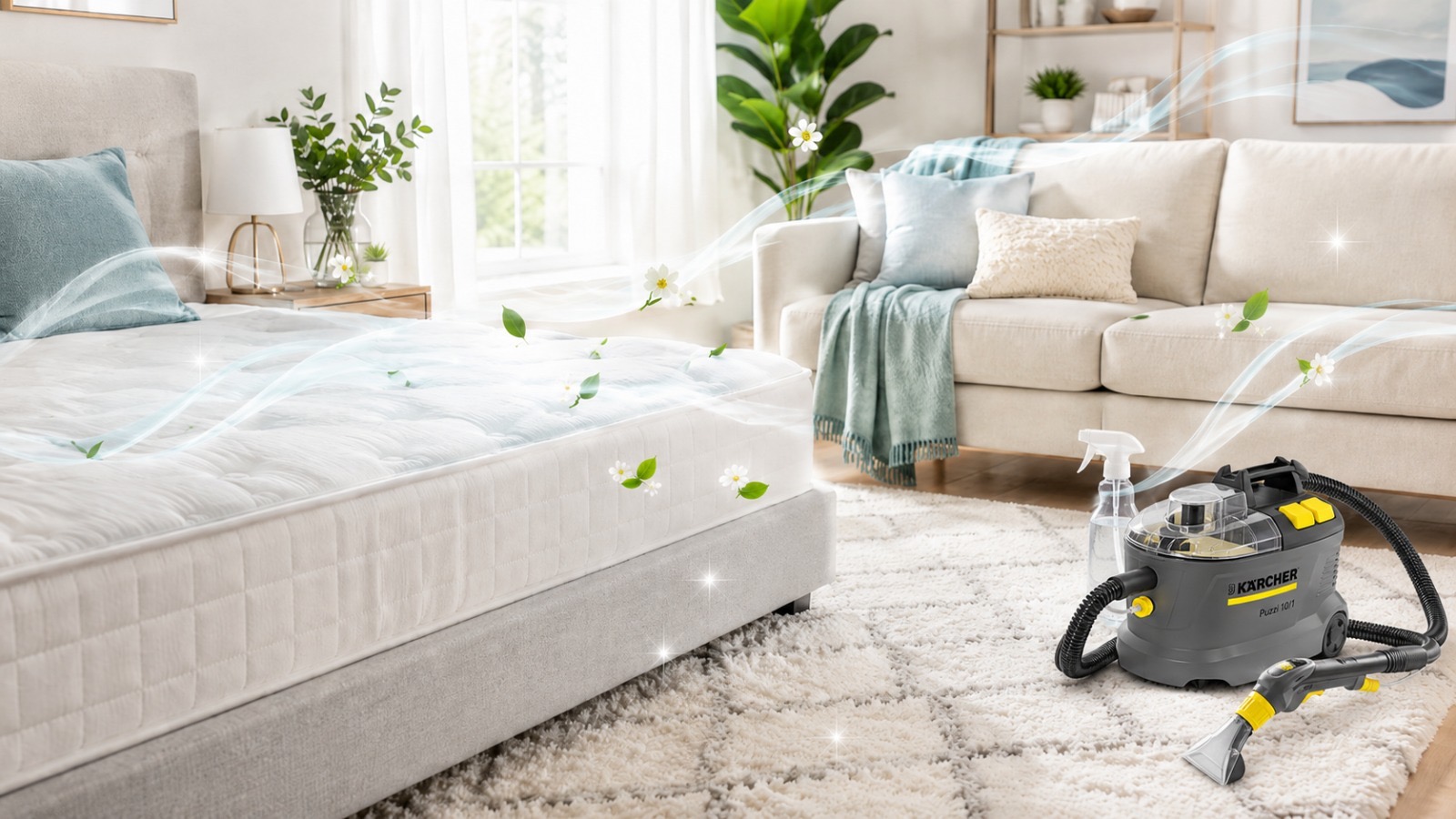
There are odours that simply cannot be ignored. You walk into a room and immediately you can smell it, the mustiness of a carpet, the smell of cat urine on the sofa, or that "old" smell in the bedroom that you can't quite place. These odours aren't easy to eliminate because they're not on the surface, they're embedded deep within the fibres, foam and upholstery of the furniture. In this guide, we'll go through each issue separately and explain what really works.
Why do odours get 'stuck' in fabrics?
Understanding the problem helps to solve it. The odour isn't just on the surface, it's molecules that bind to fibres, soak into the foam, and remain even when the visible stain has gone.
| The Source of the Odour | Type of molecules | Difficulty of removal |
|---|---|---|
| Urine (fresh) | Ammonia, urea | Medium |
| Urine (old, dried) | Urochromogen, mercaptans | Foul |
| Sweat | Fatty acids, ammonia | Medium |
| Cat urine | Feline, thiols | Very strong |
| Moisture / mould | Spores, mycotoxins | Very difficult |
| Food | Organic acids, fats | Easy to medium |
| Cigarette smoke | Tar, nicotine | Very difficult |
Smell of urine from the mattress
Fresh urine (occurred within an hour)
- Absorb as much of the liquid as possible with a dry towel (press, do not rub)
- Mix: 200 ml of 3% hydrogen peroxide, a tablespoon of bicarbonate of soda, 2-3 drops of washing-up liquid
- Spray onto the stain and leave for 10-15 minutes
- Blot with a clean cloth and leave to dry
- Once dry, sprinkle with bicarbonate of soda, leave for an hour and vacuum up.
Old urine (more than 24 hours)
Old urine is a significantly tougher problem because the chemical structure has changed, urea has broken down into ammonia and urochromogen, which penetrate deeper into the fibres. Standard remedies won't help here.
What works:
- Enzymatic cleaners: contain enzymes that literally 'eat' organic odour molecules. Available from pet shops (brands: Biozym, Nature's Miracle). They need 24-48 hours to work under a plastic sheet.
- Professional machine cleaning with a UV lamp for urine zone detection + enzyme treatment + Puzzi machine extraction
Cat urine odour
Cat urine is a special category. It contains feline and thiols (sulphur compounds) which are incredibly persistent. It's not just a "strong smell", they are chemical bonds that cannot be broken down by ordinary cleaning.
What DOESN'T work:
- Vinegar and bicarbonate of soda: temporarily masks, does not remove
- Perfume or air freshener: completely useless
- Standard detergents: do not break down thiols
What works:
- Enzymatic cleaner specific to cat urine (Nature's Miracle Cat, Biozym), be sure to read the instructions as it needs to sit for longer
- Professional treatment with a UV lamp (which reveals the entire affected area) + deep machine cleaning
- In extreme cases: replacing the mattress filling or reupholstering the sofa
Sweat odour from mattresses and sofas
Sweat itself doesn't have a strong odour, the problem arises when bacteria on the skin break down the sweat and create volatile fatty acids. These acids penetrate the fabric.
DIY method
- Mix equal parts of white vinegar and water in a spray bottle
- Lightly spray onto the surface (do not soak)
- Leave for 10 minutes
- Dry with a microfibre cloth
- Sprinkle bicarbonate of soda, leave for at least 3 hours, then vacuum up.
For a deeper-set odour
Hydrogen peroxide (3%) diluted 1:1 with water can neutralise sweat acids. But always test on an inconspicuous area as it can bleach some fabrics.
Mould and damp odours from carpets and mattresses
Moisture is the most dangerous of all as it signals the growth of mould and fungi. It's not just an aesthetic problem, mould spores can cause serious respiratory problems.
Identify the problem
- The smell of "old books", "old house" or "wet dog"
- Visible dark patches (especially at the bottom of carpets or under mattresses)
- Allergic reactions in household members with no clear cause
What to do
- Take the carpet or mattress outside into the fresh air and sun (UV rays kill mould)
- Wipe the affected area with a 1:1 solution of white vinegar and water
- Allow to dry thoroughly: for a minimum of 24 hours
- Vacuum with a HEPA vacuum cleaner (it traps spores, a standard one does not)
- Apply an anti-mould spray if the problem is more severe
Warning: If the mould covers a large area (more than 30 x 30 cm on the mattress interior), the item is a potential health hazard. Replacing it may be a safer option than cleaning.
Food odour from sofas and carpets
Fortunately, this is the easiest category. Food odours are caused by organic acids and fats that become deeply embedded in the fibres only if you don't act quickly.
- Fresh stain: blot, dab with mild soap and water
- Old stain: bicarbonate of soda for 30-60 minutes + vacuuming
- Strong smell of fried food or fish: white vinegar diluted 1:1, spray and dry
Bicarbonate of soda: wonders and limitations
Bicarbonate of soda is a magic powder that many recommend for everything, but it has its limitations.
| What it works for | What it doesn't work for |
|---|---|
| Absorption of fresh odours | Old deep urine odour |
| Neutralising acidic odours (sweat) | Cat urine (thiols) |
| Moisture absorption | Mould (only masks) |
| Surface fabric freshening | Deeply embedded chemical bonds |
When do you need professional help?
There are odours you cannot remove yourself, no matter how many products you use:
- Cat urine that has been present for more than 2 weeks
- Mould inside the mattress
- Smoke odour that has been ingrained in furniture for years
- Multiple urine odours in the same mattress
In Dugo Selo, Sesvete, Vrbovec, Sveti Ivan Zelina and Brckovljani, professional services are available that combine enzymatic treatments, deep machine cleaning and steam disinfection, the only method that truly eliminates, rather than masking, problematic odours.
Prevention: how to prevent odour build-up
- Always use a waterproof mattress protector
- Regularly ventilate the bedroom (for a minimum of 15 minutes in the morning)
- Vacuum the carpet weekly to prevent the build-up of organic particles
- Don't eat on the sofa, or at least use placemats
- Dry wet surfaces immediately: moisture + warmth = mould within 24-48 hours
Frequently Asked Questions (FAQ)
Can an air freshener permanently remove a smell?
No. Air fresheners mask odours by adding another scent, but the original problem remains. When the fragrance wears off, the odour returns. The real solution is chemical neutralisation or the physical removal of the odour source.
Is kitchen vinegar safe for all fabrics?
White vinegar (not apple cider vinegar) diluted 1:1 with water is safe for most fabrics, but it can discolour silk, wool, or heavily dyed fabrics. Always test on an inconspicuous area.
How long should bicarbonate of soda stay on the mattress?
A minimum of 3 hours, ideally all day (8-12 hours). The longer it sits, the more moisture and odours it will absorb. Cover the mattress with a clean sheet to keep the bicarbonate of soda on the surface and prevent it from spreading around the bedroom.
Is hydrogen peroxide safe for mattresses?
3% hydrogen peroxide (pharmacy strength) is safe for white and light-coloured mattresses, but it can fade dark and coloured fabrics. For dark surfaces, use an enzyme cleaner instead of hydrogen peroxide.
How to remove the smell from a second-hand sofa?
Let the sofa air out for a few days if possible, or in a well-ventilated room. Then sprinkle bicarbonate of soda and leave it for 24 hours. Professional deep cleaning is the most effective method for old, ingrained odours.
Can sun-drying eliminate odours?
Sunlight and UV rays help: they kill odour-causing bacteria and dry out moisture. But sunlight alone is not enough to eliminate cat urine or mould. It is a good supplementary method alongside a chemical treatment.
What to do if the smell is coming from the sofa's filling?
When the odour penetrates to the filling (the foam interior), the fabric on the surface can be replaced, but the filling is the problem. Professional cleaners can also treat the filling through the fabric using the Puzzi method, which physically extracts the material from deep within. In extreme cases, replacing the filling is the only option.
Can essential oils remove odours?
Essential oils (lavender, eucalyptus, tea tree) have antibacterial properties and are suitable as a supplement to cleaning, but they do not remove the chemical bonds of odours. They smell pleasant, but this is masking, not elimination.
Why does the smell come back a few days after cleaning?
Usually because only the surface odour was removed while the source stayed deeper in the padding, for example urine or a spilled drink. When the fabric warms up or gets damp, the smell comes back. An enzyme cleaner and extraction washing, which pulls the water straight back out, followed by thorough drying, help here.
How can I stop the mattress and sofa from picking up smells again?
Air the room every day, wash the bedding weekly and put a washable protective cover on the mattress. Avoid eating greasy food on the sofa and blot any spills straight away. Give your pets a blanket that you wash regularly.
Conclusion
Removing odours from mattresses, carpets and sofas isn't always straightforward, but there's a right solution for every problem. The key is to understand the source of the odour and choose the appropriate method, bicarbonate of soda for surface freshening, enzyme cleaners for urine, hydrogen peroxide for sweat and bacteria, and professional machine cleaning for anything you can't tackle yourself.
If you don't have the right equipment or simply don't feel like doing it yourself, get in touch. We can come and do the cleaning for you, or you can hire Kärcher machines and do it yourself.