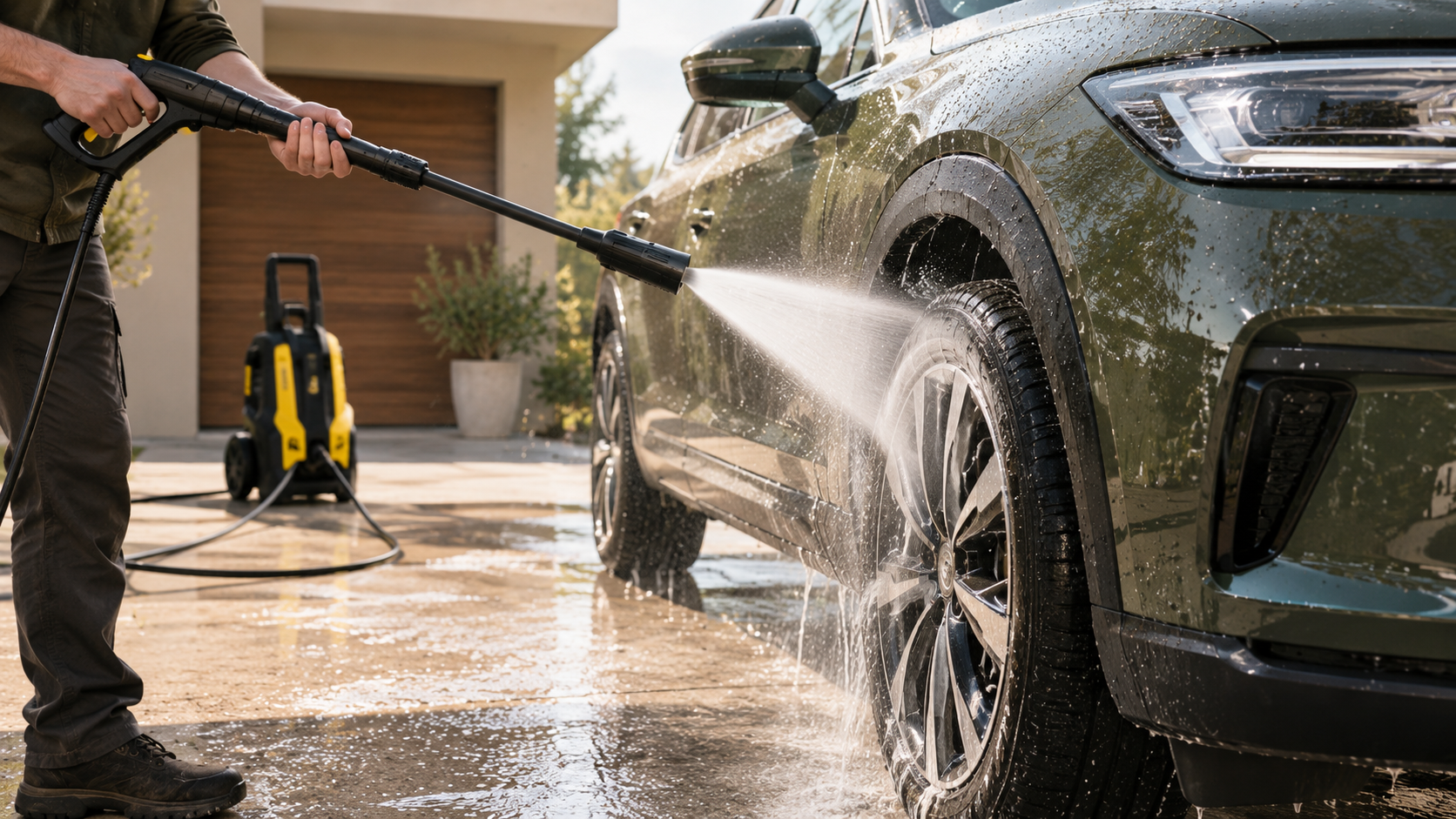
A pressure washer is excellent for washing a car: it removes mud from the sills, dust from the brakes and road salt after the winter, and you do not touch the paint with a sponge while it is still dirty. That is exactly why you scratch it less. But with the wrong nozzle or too little distance you can damage the paint, seals and tyres, so it is worth knowing a few rules.
Before washing
- park the car in the shade, because in the sun water and products dry too fast and leave marks
- check whether you are allowed to wash a car there, as some buildings and towns restrict it because of waste water
- close the windows and sunroof and fold in the mirrors
- get two buckets, a microfibre wash mitt and a drying towel ready
Which nozzle and what distance?
For the paint, use the Vario Power lance with a flat jet and keep it at least 30 cm away. For tight corners and dirtier areas, move closer carefully, never holding the jet on one spot.
Do not use the rotary nozzle (Dirt Blaster) on a car, especially not on paint and tyres. A focused, rotating jet can damage the paint, and on the tyre and its sidewall it can cause damage that is not visible straight away.
Washing step by step
- Rinse the whole car from top to bottom to remove sand and coarse dirt before you touch anything
- Apply foam or car shampoo through the Plug 'n' Clean system or a foam lance and let it work for a few minutes without drying
- Wash by hand with a microfibre mitt, from top to bottom, rinsing it in a bucket of clean water (the two-bucket method)
- Rinse everything with the pressure washer, again from top to bottom
- Dry with a soft microfibre towel so no water spots remain
Wheels, sills and underbody
The dirtiest parts of a car are the wheels and the lower bodywork. Rinse the wheels, clean them with a wheel cleaner and a soft brush, then rinse again. Wash the sills and wings from a little closer, but without lingering on one spot. After the winter, rinse the underbody and wheel arches especially thoroughly to remove the salt.
What to watch out for
- door and window seals: do not aim the jet straight at the seals, water can get inside
- stickers, wraps and damaged paint: the jet can lift the edge of a sticker or chip off damaged paint
- engine bay: do not wash it at high pressure, water can get into electronics and connectors
- sensors and cameras: do not get too close
The car interior
A pressure washer is for the outside of the car. Seats, carpets and fabrics inside are cleaned with an extraction machine, and for that you can hire a Kärcher Puzzi 10/1. For how to clean a child car seat, see our guide to car seats and pushchairs.
Frequently asked questions
Can a pressure washer scratch the paint?
The water jet itself does not scratch the paint if you use the Vario Power lance and keep at least 30 cm away. Scratches usually happen when you rub paint that still has sand on it with a sponge, so always rinse the car first.
What pressure should I use to wash a car?
Moderate. On the Vario Power lance, start with a lower setting and only increase it for dirtier areas such as the sills. For the paint, distance matters more than the pressure itself.
Can I use the rotary nozzle on wheels and tyres?
We do not recommend it. A rotating jet can damage the tyre and its sidewall, and the finish on painted wheels. Use the Vario Power lance and a brush for wheels.
What product should I use to wash a car with a pressure washer?
A shampoo or foam made for cars and pressure washers. Washing-up liquid and household products are not suitable, as they strip the protective wax and can damage the machine's pump.
Can I wash the car in the sun?
Better not. In the sun, water and products dry before you rinse them off and leave limescale marks, and hot paint is more sensitive. Wash in the shade, in the morning or evening.
Can I wash the engine with a pressure washer?
We do not recommend it. High pressure can force water into electrical connectors, sensors and electronics. Clean the engine bay with a cloth and brush, and if it is very dirty, leave it to a garage.
Can I also wash a motorbike or bicycle with a pressure washer?
Yes, but from further away and at lower pressure. Do not aim the jet at bearings, the chain, wheel hubs or electronics, as water washes out the grease and can cause rust.
How often should a car be washed?
It depends on the weather and how much you drive, usually every two to three weeks. In winter, when roads are salted, wash more often and always rinse the underbody.
Should I wax the car after washing?
It helps. Wax or a protective spray on clean, dry paint makes the next wash easier, because dirt does not stick as well and water runs off better.
Why are there white marks after drying?
That is limescale from water that dried on its own. Dry the car with a microfibre towel straight after rinsing, and if marks remain, wipe them with a damp cloth and dry again.
No pressure washer? Hire a Kärcher K 7 from us and wash the car, the patio and the garden furniture with one hire.