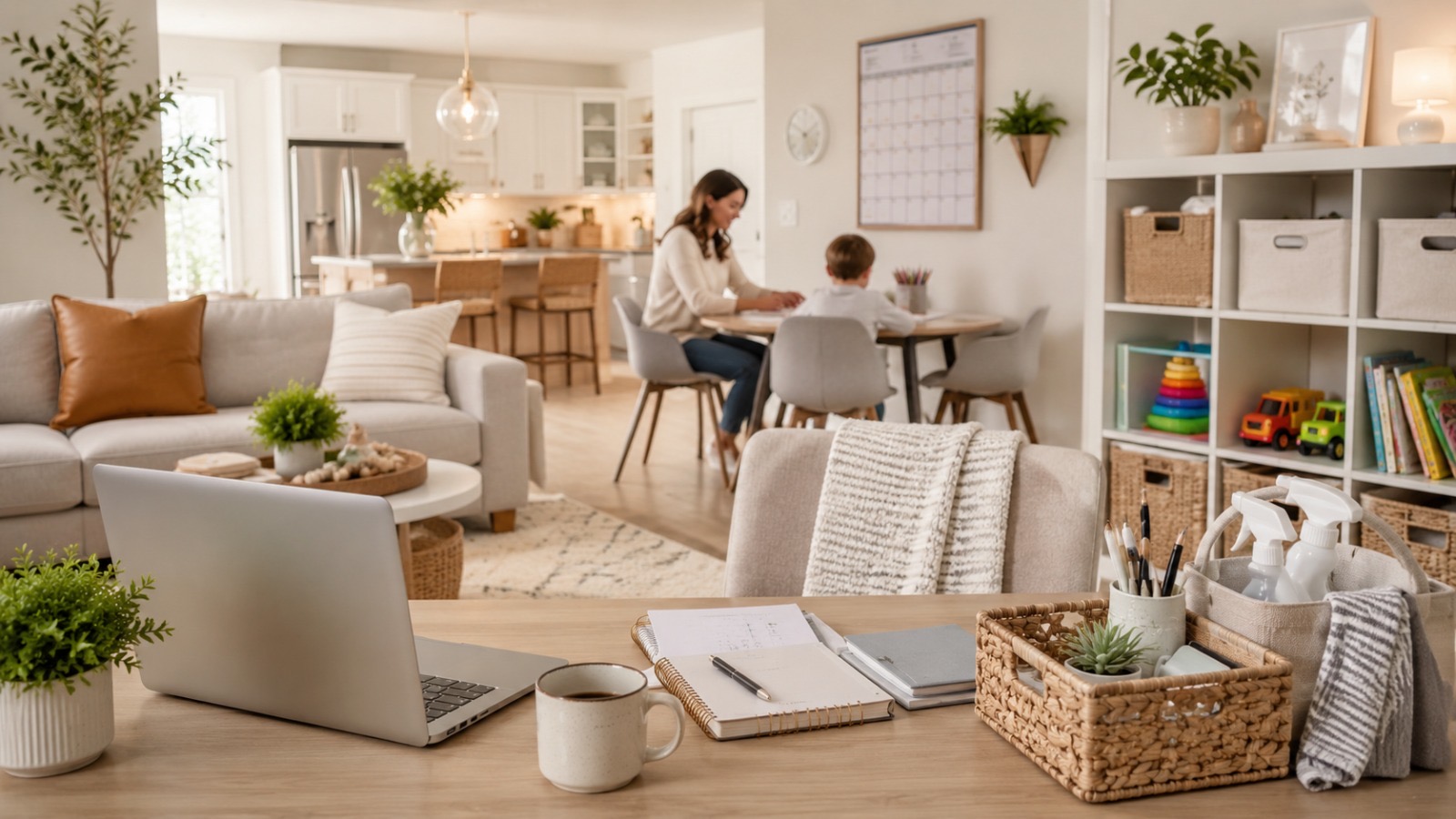
Working parents with children are in a constant war with mess. The morning rush, getting home at 6pm, homework, cooking, bath time, and finally, the kitchen looks like it's been bombed, and the living room as if teenagers have been through it (perhaps they have). A tidy home with a job and children isn't a myth, but it requires strategy, not more effort.
A change of perspective: the goal isn't perfection, it's functionality
The first and most important change: give up on the idea of a perfectly clean home. The goal for a working family isn't to accept chaos, it's to be "presentably tidy," which can be achieved in 15-30 minutes a day. Accept that there will be mess, but plan how to manage it, not eliminate it.
Strategy 1: Every item has its place
The quickest way to clean up is to have a place for everything. If there's no space, you're creating a permanent mess:
- A shoebox in the hallway: shoes at the door, not all over the flat.
- A hook for bags and coats, not chairs and sofas
- A drawer for 'temporary' things, mail, keys, small items
- Children's toys in defined zones (a box, a shelf), not all over the house
Strategy 2: Daily mini-routine (15 minutes)
Fifteen minutes at the end of the day saves the weekend:
| Task | Duration | Who |
|---|---|---|
| Kitchen: wipe down worktops, load the dishwasher | 5 mins | Adults |
| Living room: putting toys, books, and cushions back in place | 3 min | Children + adults |
| Bathroom: quick wipe of the basin | 2 min | Adults or children (10+) |
| Hallway: shoes in their place | 1 min | Everyone |
| Table: nothing is left on the table overnight | 2 min | Everyone |
| Washing machine: loading/unloading | 2 min | Adults |
Strategy 3: Robot vacuum (game-changer)
A robot vacuum is perhaps the most effective investment for busy families. Set it to run every day while you're at work or when the children are asleep:
- Eliminates daily manual hoovering (1-1.5 hours per week)
- Floors are always presentable
- Especially useful with pets (fur)
- Modern robots: Wi-Fi controlled, map-making, self-emptying
- Limitations: corners, along walls, stairs, furniture, requires weekly manual cleaning
Strategy 4: Age-appropriate chores
Children can and should take part in household chores, it develops responsibility and reduces the burden on parents:
| Age | Example tasks |
|---|---|
| 3-5 years | Putting away toys, helping to set the table |
| 6-8 years | Making the bed, carrying the laundry basket, dusting low surfaces |
| 9-12 years | Hoovering the room, loading/unloading the washing machine, mopping the room floor |
| 13+ years | Cooking simple meals, cleaning the bathroom, mowing the lawn |
Strategy 5: The Zonal Cleaning Approach
Instead of one long weekend clean, one zone each day:
- Monday: bathrooms + toilet
- Tuesday: a more thorough kitchen
- Wednesday: dusting + living room floors
- Thursday: bedrooms
- Friday: hallway, entrance hall, balconies
- Saturday: washing bedding + laundry
- Sunday: day off (or catch-up if the week has been mad)
Strategy 6: Minimising dirt-trapping textiles
- Fewer cushions on the sofa = less tidying up
- A mat that's easy to wash (not a plush one that collects fur)
- A smooth floor (laminate, ceramic) in the child's room is easier to clean than a carpet
- Closed cupboards instead of open shelves (less dust)
Seasonal and annual cleaning: when to do it?
For busy families, seasonal deep cleaning should be planned in advance, not impulsively:
- Spring (April/May): A Saturday or Sunday with a Puzzi 10/1 hire for carpets and upholstery + an SC5 for the bathroom
- Autumn (September/October): Same plan, before the indoor season
- Total: 2 weekends a year for a thorough reset + daily mini-routines
More on cleaning organisation: Home Cleaning Organisation and Home Cleaning Schedule.
Tech Help
- Robot vacuum: hands-free floors
- Tumble dryer: clothes aren't on the radiator for weeks
- Dishwasher: a cycle takes 2 minutes, just wash
- Scheduling apps: OurHome (assigning tasks to household members), Tody (tracking cleanliness by room)
- Voice assistants (Alexa, Google), reminders to remind you to put the laundry in the washing machine
Local context
Families in Dugo Selo, Sesvete, Brckovljani, Vrbovec and Sveti Ivan Zelina with busy schedules and children find that a combination of daily mini-routines + seasonal deep cleaning of the home (Puzzi + SC5 once every six months) provides a sustainable balance between a clean home and normal family life. Professional deep cleaning once or twice a year is an increasingly popular option for families who want a reset without sacrificing their weekends.
Weekly plan for a busy family
- ☐ Daily mini-routine (15 mins): every day
- ☐ Robot vacuum: every day (automatically)
- ☐ Washing machine: every other day or 2-3 times a week
- ☐ One room/zone per week, more thorough
- ☐ Bed linen: weekly wash at 60°C
- ☐ Bathroom: quick wipe-down 2x a week, deep clean once a week
- ☐ Children's chores, daily, depending on age
Frequently Asked Questions (FAQ)
How much time can be saved with a robot vacuum?
An average family (80 m²) without a robot spends 1-1.5 hours a week vacuuming. The robot eliminates 80% of that, you manually clean the corners and stairs once a week (15-20 mins). Total saving: 50-70 minutes per week, or 40+ hours a year. Annually, that's a week of free time. The robot's ROI is really in time, not money.
How to motivate children to help with chores?
Children up to 8 years old: imitate adults, cleaning together as a 'game'. Children 9-12: weekly pocket money linked to completed chores (a reward, not a punishment). Teenagers: autonomy, "your room, your responsibility" plus contributing to communal areas. The OurHome app with points and rewards is popular for children aged 7-14. The key: consistency and clear expectations, not perfect execution.
Is it better to clean in the morning or in the evening?
It depends on your family's rhythm. Morning routine (5 mins): make beds, wipe down kitchen from breakfast. Evening routine (10-15 mins): put everything away, kitchen clean, washing machine on (to finish overnight). For working parents, the evening routine is usually more efficient as the day is done and there are no interruptions. Morning cleaning is great if you have early risers who help out.
How many hours a week does it realistically take to maintain a tidy home?
For "presentable tidy" (not perfect): 5-8 hours a week for a family of 4 in an 80 m² flat. With a robot vacuum: 3-5 hours. With children sharing chores: 2-4 hours for the adults. Plus 2 weekends a year of 4-6 hours each for seasonal deep cleaning. Realistically, 30-40 minutes a day spread throughout the week is the formula that works.
How to stop the flat from falling into chaos over the weekend when we're all at home?
Weekend mess is normal. Control measure: a "reset" at 7-8 pm (15 mins together, everyone on their own task, put everything away). Sunday morning: a quick tidy of the communal areas (not rooms). "No one goes to bed until the kitchen is clean", a consistent rule for all household members, no exceptions.
What's the single most effective tool for a busy family?
A robot vacuum cleaner. Immediately after it: the dishwasher. These two appliances eliminate the two longest daily household chores. Third place: microfibre cloths (cleaner, faster and better than cotton wool or a paper towel). Fourth: a tumble dryer. Advanced: the SC5 for a quarterly, chemical-free bathroom deep clean in 30 minutes.
Can seasonal deep cleaning be fitted into a weekend without disrupting the family routine?
Yes: with planning. Hire a Puzzi 10/1 and an SC5 on Saturday morning, clean the carpets and furniture while the children are out (e.g. at training, at their grandmother's). Drying in the afternoon. Bathroom with the SC5 in 1-2 hours. By Sunday afternoon, everything is dry and clean. The children could have helped too, part of the seasonal clean is a great family experience (especially watching the dirty water come out of the Puzzi).
Is there a strategy for reducing clutter without constant tidying?
The "one in, one out" rule: every new item that comes into the house means one must go. Declutter toys: too many toys create more mess than fewer, rotate them (put some away, bring some out on a weekly schedule). Use boxes for each category of items. No "it can just stay here temporarily", temporary becomes permanent within 48 hours.
How do I organise the weekly shopping for cleaning products?
Keep a short list of basic products and supplies, and as soon as something is half used, add it to the shopping list. Buy all-purpose products that cover several surfaces, so you need fewer bottles. Keep everything in one place, in a box or caddy you can carry around the flat.
How do I keep children's toys in order?
Give each type of toy its own box with a label or picture, so even small children know where things go. Tidy up together for five minutes before bed each evening. Put some of the toys away now and then and swap them back in after a few weeks, so there are fewer on the floor and the children find them interesting again.
Conclusion
A tidy home with a job and children isn't a matter of discipline, it's a matter of system. With a 15-minute daily routine, a robot vacuum, and clear family chores, the home can be presentably tidy without you finishing the week exhausted from cleaning. And a seasonal deep clean (Puzzi + SC5) once every six months ensures that the little things don't grow into a big problem.
If you don't have the right equipment or simply don't feel like doing it yourself, get in touch. We can come and do the cleaning for you, or you can hire Kärcher machines and do it yourself.