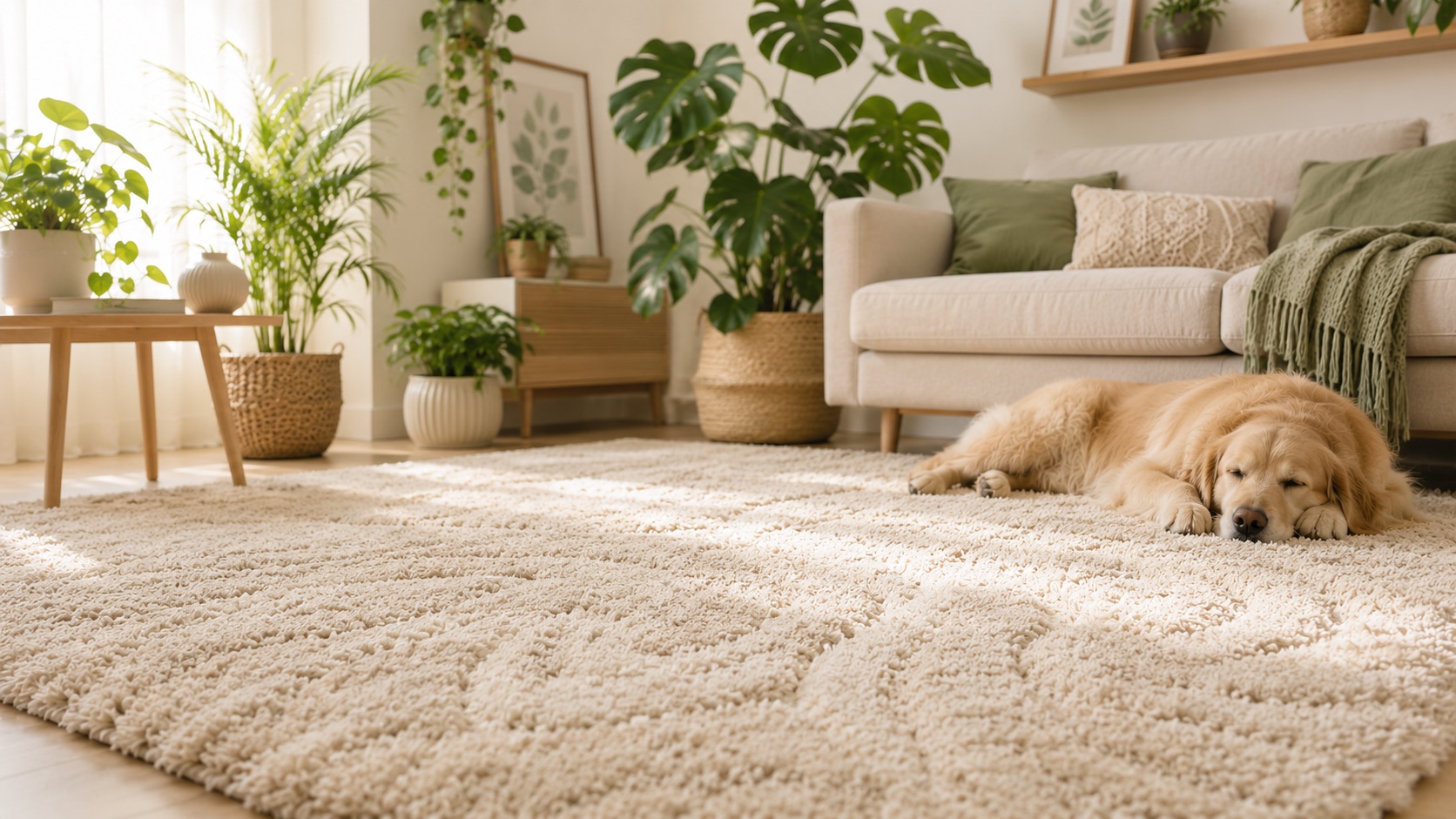
A carpet that looks tidy may well be tidy, but only on the surface. Carpet fibres act as a filter that collects everything: dust, mites, hair, bacteria, mould, food debris and chemicals we bring in on our shoes. Microbiologists who have measured household surfaces found that an average carpet can hold far more bacteria than a toilet seat. How often does it need a deep clean, and with what?
Why regular vacuuming is not enough
A vacuum cleaner with a HEPA filter removes particles from the top third of the fibres. Deep in the carpet you are left with:
- dust mites and their allergens, which live 2-4 cm deep
- bacteria in the fibres
- grease and organic residue that "glue" particles in place
- dirt brought in on shoes (pesticides, heavy metals, oils)
- spilled liquids that have dried in the fibres
Only deep cleaning by extraction penetrates the whole fibre and truly cleans the carpet.
How often, depending on who lives in the home
| Who lives there | Vacuuming | Deep cleaning |
|---|---|---|
| 1-2 adults, no children or pets | Once a week | Once a year |
| Family with school-age children | 2-3 times a week | Twice a year, in spring and autumn |
| Family with young children | Every day | 3-4 times a year |
| One small dog or cat | Every day | 3-4 times a year |
| Several pets or large dogs | Twice a day or with a robot | Every 2-3 months |
| Allergy and asthma sufferers | Every day, with a HEPA vacuum | Every 3 months |
| Older carpet, 5 years or more | Every day | Every 3 months |
Signs your carpet URGENTLY needs a deep clean
- darker tracks where people walk most
- an unpleasant smell that stays after vacuuming
- flattened, dull fibres that don't spring back
- allergy symptoms that get worse when you're on the carpet
- stains that ordinary cleaning didn't shift
- the carpet hasn't been deep cleaned for over a year
Ways to deep clean a carpet
1. Warm water extraction, the best method
This is how the Kärcher Puzzi 10/1 works: it injects warm water and cleaning solution into the fibres under pressure and immediately sucks it back out along with the dirt. Advantages:
- it penetrates deep into all the fibres
- warm water and rinsing remove mites and bacteria
- the carpet dries faster, in 2-6 hours instead of 24 or more
- no detergent residue is left to attract new dirt
- it is the best choice for allergy sufferers
2. Dry cleaning
A powder is applied, worked in and vacuumed up. The advantage is that there is no drying, the drawback that it doesn't penetrate deeply and leaves chemicals in the fibres.
3. Shampooing
Shampoo and a vacuum. Useful for fresh surface stains, but the foam leaves residue that attracts new dirt. We don't recommend it for deep cleaning.
4. Steam (SC5)
Steam kills mites and disinfects, but it doesn't extract dirt from the fibres. It is useful for disinfecting between Puzzi cleans, but cannot replace them.
Why the Kärcher Puzzi 10/1 is the standard for carpets
The Puzzi 10/1 is an extraction cleaning machine you can hire from us. Its advantages:
- large tanks for clean and dirty water, so you rarely have to stop
- you fill it with warm water and cleaning solution
- the pressure is suited to textiles and doesn't damage the fibres
- the carpet dries in 2-6 hours, much faster than after cheaper machines
- it cleans carpets, upholstery, car seats and mattresses
More about hiring and using it in the article Kärcher Puzzi 10/1: buy or hire.
Drying the carpet, a crucial step
A carpet that hasn't dried properly is worse than an uncleaned one, because moisture encourages mould and bacteria. How to dry it quickly:
- open a window straight after cleaning so the air circulates
- point a fan at the carpet
- turn on the heating if it's cold outside
- don't cover the carpet or walk on it until it is completely dry
- check: press a white paper towel firmly onto the carpet, and if it comes up damp, the carpet isn't dry yet
Everything about drying is in the guide Drying after deep cleaning.
A yearly plan for your carpet
- Every day or every other day: HEPA vacuum, essential with pets or allergy sufferers
- Weekly: regular vacuuming
- In spring (April): deep clean with the Puzzi, a seasonal refresh
- In autumn (September): deep clean with the Puzzi, before the indoor season
- As needed: treat stains straight away, without waiting
Deep carpet cleaning in our area
Carpet owners in Dugo Selo, Sesvete, Vrbovec, Brckovljani and Sveti Ivan Zelina with children or pets notice fewer allergy symptoms and a fresh-smelling room after a deep clean with the Puzzi. Seasonal cleaning in spring and autumn, together with regular HEPA vacuuming, keeps the carpet hygienic and extends its life. If you'd rather not do it yourself, book a deep carpet clean.
Checklist for deep cleaning a carpet
- ☐ vacuum the carpet with a HEPA vacuum to remove loose particles
- ☐ pre-treat stains with a suitable product and wait 10 minutes
- ☐ fill the Puzzi 10/1 with clean warm water and cleaning solution
- ☐ clean in the direction of the fibres
- ☐ make a second pass with clean water to rinse
- ☐ drying: windows, fan and heating
- ☐ check it's dry with the towel test, after at least 4-6 hours
- ☐ vacuum once more when it's completely dry
Frequently asked questions
Can deep cleaning too often damage a carpet?
Properly done warm water extraction doesn't damage a carpet if the pressure and temperature are right. What does harm a carpet is too many chemicals, staying damp for too long because of poor drying, and water that is too hot for synthetic fibres. The Puzzi with a suitable cleaning solution is safe for all types of carpet, including wool.
How long does deep cleaning a carpet with a Puzzi take?
For an average 3 x 4 metre carpet, 20-40 minutes of work, plus 10-15 minutes of preparation (filling with water, tidying the room, vacuuming). Drying takes 2-6 hours with good ventilation, and up to 24 hours without. The carpet is ready when it is completely dry, which you can check with a paper towel.
Can a carpet be deep cleaned in both summer and winter?
Summer is ideal, as longer days, warmth and open windows mean the carpet dries quickly, in 2-4 hours. Winter is slower, but it works with good heating and ventilation. Never clean a carpet below 15°C without heating, as it takes too long to dry and the risk of mould rises.
Does a new carpet, less than a year old, need cleaning?
To the eye, no, but microbiologically, yes. A new carpet collects mites and bacteria from the very first week. Allergy sufferers should deep clean even a new carpet every 6 months. In a healthy household without allergies, once a year is enough for a carpet under three years old.
Can a robot vacuum replace deep cleaning?
No. A robot is great for daily surface cleaning and keeping dust down, but it doesn't penetrate deep into the fibres or extract mites. It is a supplement, not a replacement. Use the robot every day and the Puzzi for a seasonal deep clean.
What if a smell in the carpet doesn't go with vacuuming?
It means there is organic matter deep in the fibres: mites, bacteria, dried liquids or pet urine. Bicarbonate of soda left for 2-4 hours and then vacuumed eases the smell for a while. A lasting fix is a deep clean with the Puzzi, which literally pulls the source of the smell out of the carpet. For pet urine, use an enzyme urine cleaner and then the Puzzi.
Is it worth deep cleaning an old carpet, or is it better to replace it?
Replace a carpet that is over 10-15 years old with permanently damaged fibres, permanent stains or visible wear. A carpet in good condition, without permanent damage, that simply hasn't been cleaned for a long time will be refreshed by a deep clean, adding 3-7 years to its life. A day's machine hire costs a fraction of a new carpet, which can easily run to several hundred euros or more, so the maths is clear.
How many dust mites does a Puzzi clean remove?
Warm water extraction, combining warmth and rinsing, removes a large share of mites and their allergens from the fibres. The mites that survive are deeper in the carpet backing. If you vacuum the carpet again with a HEPA vacuum 24 hours after cleaning, once it is dry, you will remove a good part of the rest.
How do I remove furniture dents from a carpet?
Put an ice cube on the dent and let it melt, then once the fibres are damp, lift them with your fingers or a brush and let them dry. On synthetic carpets you can also briefly steam from a distance and then comb the fibres. This brings the fibres back to their original shape.
How do I clean a long-pile (shaggy) rug?
Vacuum it without the rotating brush or on the highest setting so the long fibres do not tangle. Blot stains, never rub, and for deep cleaning use as little water as possible and let the rug dry longer than a regular one. If it is very dirty, leave it to the professionals.
Conclusion
A carpet that is deep cleaned regularly is hygienically safe, lasts longer and makes the home healthier. The formula is simple: a HEPA vacuum every day and a deep clean with the Puzzi twice a year, in spring and autumn, and your carpet will be hotel standard.
If you don't have the right equipment or simply don't feel like doing it yourself, get in touch. We can come and do the cleaning for you, or you can hire Kärcher machines and do it yourself.