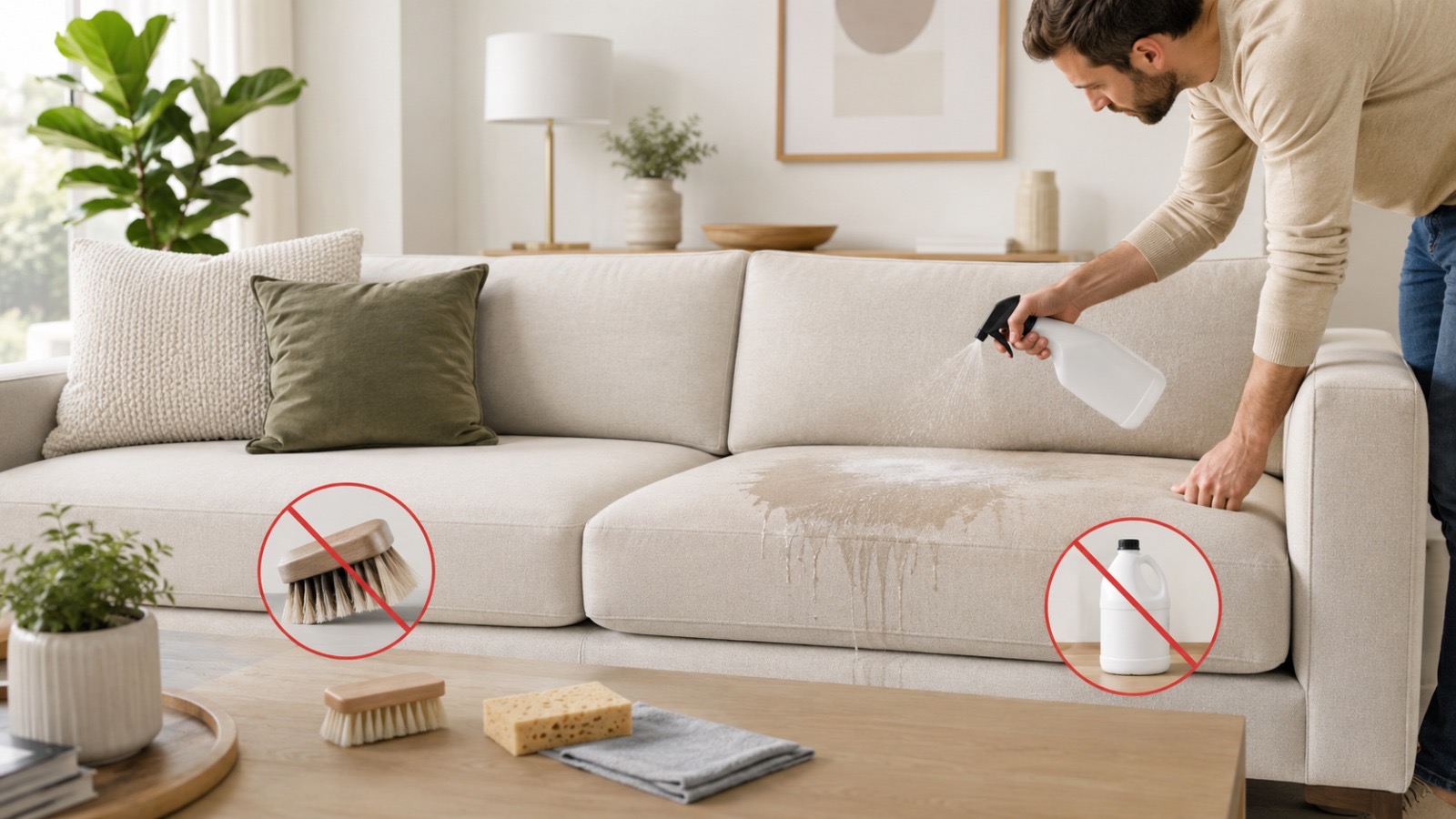
The sofa is perhaps the most used piece of furniture in the home, and one of the most sensitive to clean. Every stain causes panic, and panic leads to quick and wrong decisions. Rubbing with a cloth, pouring too much water, or using the wrong cleaning agent can destroy fabric in minutes that would otherwise last for decades. Here are 7 mistakes people most often make and what to do instead.
Mistake 1: Rubbing the stain instead of blotting
This is the number one mistake. The natural instinct is to grab a cloth and start scrubbing, it sounds logical, but it's completely wrong.
What happens when you rub?
- The stain spreads horizontally across the surface (it gets bigger)
- It drives the liquid deeper into the fibres and the furniture's foam
- It damages the fabric fibres: especially microfibre and velour materials
- The stain gets 'tamped' into the fabric and becomes more permanent
What to do instead?
Blot: press a clean white cloth or kitchen roll onto the stain, lift it, press again. Work from the edges towards the centre. Each press transfers a little of the stain to the cloth. Patience is key.
Mistake 2: Not reading the fabric label
Every sofa has a label that tells you which cleaning methods are permitted. Ignoring that label is like treating an illness without a diagnosis.
| The label | What this means | What NOT to use |
|---|---|---|
| W | Water OK | Solvent-based products |
| S | Solvent only | Water in any quantity |
| WS | Both | Aggressive chemicals |
| X | Only professionally | All: do not attempt anything yourself |
Fabric with an S label that comes into contact with water can shrink, change colour or be left with a permanent drying stain. Once that happens, there's no going back.
Mistake 3: Using too much liquid
More isn't better when it comes to cleaning a sofa. Too much liquid, whether it's water or cleaner, soaks through the fabric to the foam interior. This foam absorbs moisture and doesn't dry easily. The result:
- The sofa stays damp for a long time (the ideal conditions for mould)
- The foam develops a 'wet dog' smell
- Dark marks are left on the surface from drying
- Mould can develop within 24-48 hours
Rule: The cloth should be damp, not wet. If you can wring liquid out of the cloth, it's too dry. If it's dripping, it's too wet. You need to be somewhere in between.
Mistake 4: Using a general-purpose cleaner for the kitchen or bathroom
White vinegar, oven cleaner, Domestos, floor cleaner, they all sound like cleaning agents, but none of them is suitable for upholstered furniture.
- Oven cleaners are bases (pH 12+) that break down fabric fibres
- Bleach (chlorine/Domestos) removes the fabric's colour, permanently
- Floor cleaners leave a film that attracts dirt
- Vinegar is acidic (pH around 2.5) and can fade certain fabrics
What to use: A specialist upholstery cleaner or a mild liquid washing-up liquid diluted in water (2-3 drops per half a litre of water). For leather furniture, use only a leather cleaner.
Mistake 5: Drying with a hairdryer or heater
In a hurry to get the sofa dry? Understandable, but heat is the enemy of fabric and leather.
- Heat shrinks natural fibres (wool, cotton, linen)
- On a leather sofa, dry air causes cracking and flaking.
- Some synthetic fabrics melt or deform at high temperatures
- Rapid drying 'sets' stains that haven't been completely removed
The right solution: Open a window, switch on a fan on a cool setting, or simply wait patiently. The sofa will dry in 2-6 hours, depending on the fabric's thickness and the humidity.
Mistake 6: Testing the cleaner on a visible part
Any new cleaning product should be tested on an inconspicuous area of fabric, the back of the sofa, the inside of a seat cushion, or under a cushion. It sounds obvious, but ask any professional cleaner and they'll tell you that customers regularly call them with problems that have arisen because they didn't test it first.
Apply a small amount of the product, rub in gently, leave for 10 minutes, and see:
- Has the colour changed?
- Has the fabric shrunk?
- Does it leave a mark when it dries?
If it all looks good: you can apply it to the visible area. If there are any changes, do not use that product.
Mistake 7: Waiting for the stain to 'dry on its own' and then cleaning it
The hardest cleaning agent is waiting. A fresh stain is 10 times easier to remove than an old one. When a stain dries, the fibres hold it firmly, and the liquid that carried the stain evaporates, leaving a condensed layer of dirt.
Stain Timetable by Time
| When cleaning | Cleaning Difficulty | Chance of complete removal |
|---|---|---|
| Immediately (0-10 mins) | Easy | High (80-95%) |
| Up to an hour | Medium | Medium (50-70%) |
| After 24 hours | Difficult | Low (20-40%) |
| After a week | Very difficult | Minimal: needs mechanical cleaning |
Bonus mistake: Neglecting regular maintenance
Stain cleaning is a remedial action. Regular maintenance is a preventative measure that reduces them. Weekly vacuuming with a upholstery tool removes 80% of dirt and hair before it becomes embedded in the fibres. That's the difference between a sofa that looks good for three years and one that looks good for ten years.
Practical guide: what to do immediately when a stain occurs
- Grab a clean white cloth or kitchen roll
- Blot (press, lift, repeat) from the edges towards the centre
- Never rub: this is rule number one
- For liquid stains (coffee, wine), blot up as much as you can with a dry material.
- For solid stains (food): scrape off with a knife or spoon BEFORE damp treatment
- Apply a little of the cleaner (tested) to a cloth, not directly onto the fabric
- Blot until the stain is gone
- Blot with a clean, dry cloth and leave to air dry
Local perspective: Dugo Selo and surroundings
If you have a sofa with a stain in Dugo Selo, Sesvete, Vrbovec, Sveti Ivan Zelina or Brckovljani that you can't remove yourself, professional machine cleaning using the Kärcher Puzzi method can remove even stains that are several weeks old, but the sooner you act, the better the result.
Frequently Asked Questions (FAQ)
What should I do if I've already made a mess of it and spread the stain?
Stop cleaning, let it dry completely and only then assess the damage. Sometimes the stain disappears when it dries. If it remains, call in the professionals, any wet intervention at this point will only make the situation worse.
Can a sofa be cleaned with a steam cleaner?
Yes, but only for fabrics with a W or WS label. Steam can shrink some fabrics and is not recommended for leather. Always test on an inconspicuous area. A steam cleaner is excellent for disinfecting and removing dust mites.
How to remove the water mark left after drying?
Dampen the entire seat area with a damp cloth (not just the stain), then allow it to dry evenly. A water mark occurs when drying is uneven, if everything dries at the same time, the mark disappears. Sometimes it takes 2-3 repetitions.
Should fabric protector be used regularly?
It is recommended to apply a fabric protector spray every year or after each professional clean. It creates an invisible protective layer that gives you more time to react when a stain occurs and reduces the depth of liquid penetration.
What if the sofa has two different fabrics?
Every fabric has its own label and its own rules. Find both labels and use a product that is safe for BOTH fabrics. When in doubt, professional cleaning is the safer choice.
Can lemon juice remove stains?
Lemon juice is an acid (pH around 2) that can fade some fabrics. It is not recommended for cleaning sofas, except on pure white cotton fabrics where it can help with oxidation stains. For other fabrics, use special products.
Is microfiber better than a cotton cloth?
Yes, for cleaning upholstered furniture, microfibre is better. It traps more particles and moisture, doesn't leave fibres on the fabric, and doesn't scratch the surface. Cotton cloths can leave behind fibres and are not as absorbent.
Should I buy a professional cleaner or a household one?
For regular cleaning, a domestic upholstery cleaner (Vanish Fabric, HG, or similar) is sufficient. For deep cleaning or stubborn stains, professional cleaners are more effective. When hiring a Puzzi machine, the cleaner is usually included or available with the machine.
How often should a sofa be vacuumed?
If the sofa is used every day, vacuum it once a week with the upholstery nozzle, and once a month also between the cushions and in the seams. That keeps dust and crumbs from working deep into the fabric, so it needs deep cleaning less often.
When is it better to call in professionals than to clean it yourself?
When the fabric is delicate (velvet, silk, linen), when the stain is old and large, or when you have already tried to remove it and it spread. In those cases the risk of permanent damage outweighs the savings. For regular care, a vacuum cleaner and a machine you can hire are enough.
Conclusion
Cleaning a sofa isn't complicated, but it does require discipline and know-how. The seven mistakes described in this text are responsible for most of the upholstery damage we see during professional cleanings. Remember: dab, never rub, read the label, use a small amount of liquid and act immediately.
If you don't have the right equipment or simply don't feel like doing it yourself, get in touch. We can come and do the cleaning for you, or you can hire Kärcher machines and do it yourself.