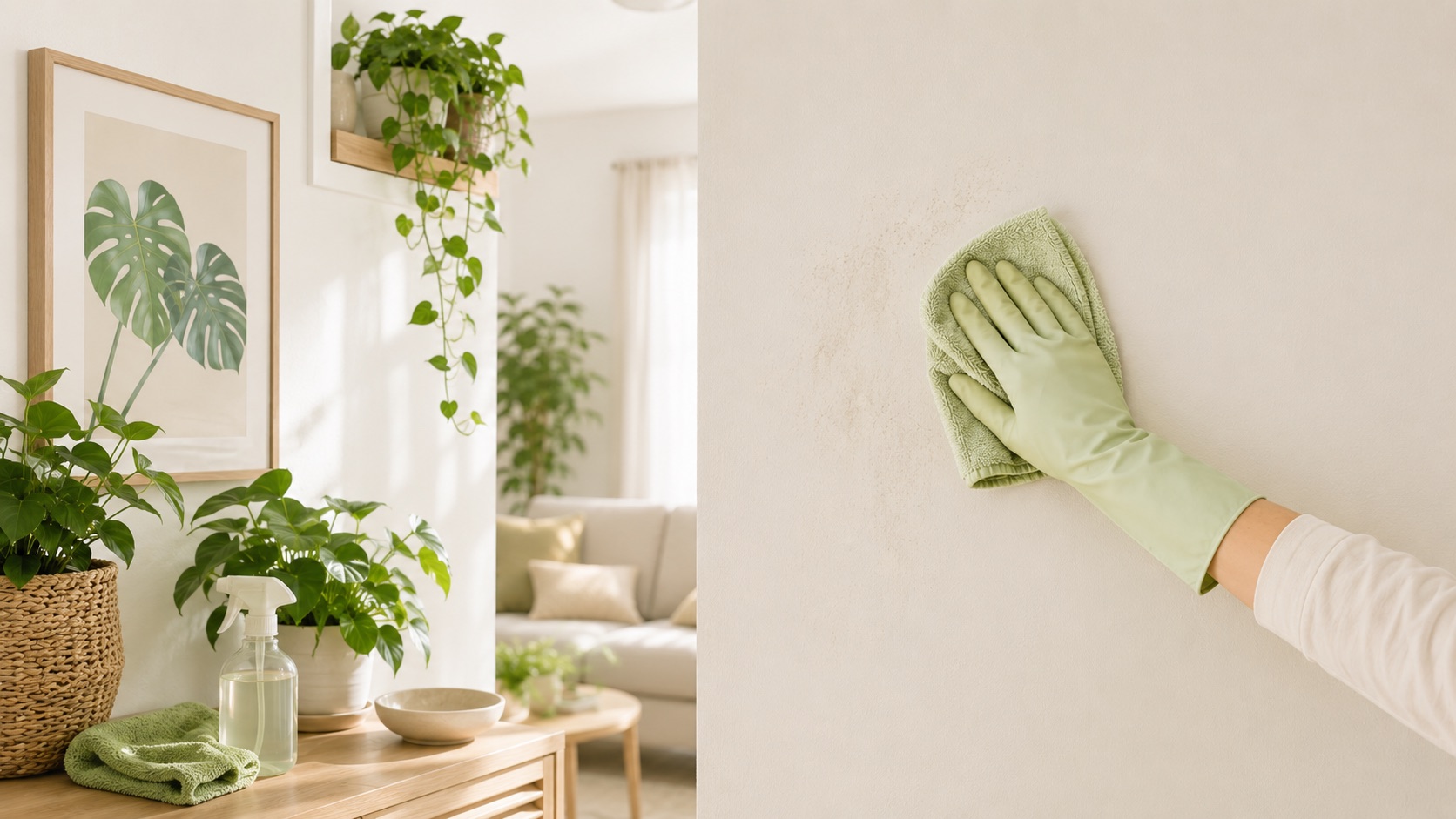
Walls are the backdrop to every home, and that's precisely why we don't notice them until they become visibly dirty. Fingerprints around light switches, a yellow nicotine tint, food stains in the kitchen, dust gathering in every nook. Cleaning walls sounds simple, but it's full of pitfalls. The wrong cleaning agent or too much moisture can damage the paint, cause it to peel or leave stains worse than the original. This guide covers all types of wall coverings and all kinds of stains, with the correct method for each.
Types of wall finishes and what they can withstand
| Type of coating | Characteristics | Moisture resistance | What to avoid |
|---|---|---|---|
| Matte paint (dispersion) | Matt finish, absorbs moisture | Low | Damp cloths, scrubbing |
| Semi-matte (satin) | Slight sheen, easier to clean | Medium | Abrasives |
| Gloss lacquer (gloss) | High gloss, waterproof | High | Abrasion (scratches) |
| Washable paint | Marked as 'washable' | High | Strong acids/bases |
| Wallpaper: paper | Very sensitive to moisture | Very low | Wet cleaning |
| Wallpaper: vinyl | Waterproof, easy to clean | High | Solvents |
| Wallpaper: fabric | Absorbs moisture and stains | Very low | Wet cleaning |
General rule: test on an inconspicuous area
Before using any product or method, always test it in a hidden corner (behind a door, behind a cupboard) and allow it to dry. This step prevents potential damage to the entire wall.
Cleaning matt paint: the most sensitive type
Matt paint is the most sensitive to moisture and abrasion. Mistake: an overly wet cloth that dilutes and 'wipes' the paint. Correct method:
- A dry microfibre cloth or an electrostatic duster, for dust (always dry first)
- A nearly dry cloth (wrung out to the maximum) for a lightly damp wipe
- Wipe with light strokes: do not rub
- Immediately dry with a dry cloth
For stains on matt paint: the recommended technique is to gently rub with a white eraser for fresh stains, and to lightly dampen only the spot of the stain, not the entire wall.
Cleaning washable paint and gloss lacquer
These are the most practical types of coating for wet cleaning:
- Microfibre cloth soaked in a mild solution (a drop of washing-up liquid per litre of water)
- Wipe from top to bottom
- Rinse with a clean, damp cloth
- Drying with a dry cloth
For greasy kitchen walls: diluted degreaser or a bicarbonate of soda paste on glossy paint. On matt paint in the kitchen, only a damp cloth with mild soap and extreme care.
Removing specific types of stains
Fingerprints
- Fresh: dry microfibre cloth or white eraser
- Old: a drop of liquid soap on a damp cloth, gently dabbing (not wiping)
- Area around the switch: the most frequently soiled spot, check and wipe weekly
Food and drink stains
- Immediately: dry paper towel to absorb, do not rub
- After drying: damp cloth + mild soap, dabbing
- For stubborn stains: 3% hydrogen peroxide (spot test on an inconspicuous area!) dab onto the stain
Nicotine yellowing
Nicotine builds up a yellow film over time on all surfaces, especially noticeable on white and light-coloured walls. Removal methods:
- A mixture of warm water, white vinegar and a drop of washing-up liquid, use it to carefully wipe a small area at a time
- Bicarbonate of soda paste: on heavily yellowed areas, testing essential
- For heavily nicotine-stained walls: a professional anti-nicotine primer and repainting is the only permanent option
Markers and pen (children's drawings)
- White eraser (Magic Eraser or a standard one) for fresh pencil drawings
- Rubbing alcohol (70% isopropyl) on a cotton wool ball, dab on the marker (testing required)
- Toothpaste (white, non-gel) on a soft cloth, gentle abrasion for old pencil marks
Mould (black spots)
Mould on walls is a special topic, covered in detail in the guide Mould in the Home: Causes and a Permanent Solution. In short: 3% hydrogen peroxide or white vinegar for mild mould, chlorine gel for heavy mould. The moisture source must be addressed.
Wallpaper: a special approach
Paper wallpaper
It can hardly be wet-cleaned. Methods:
- Dry cloth or soft dusting brush
- Fresh stains: gently dab without wetting
- White bread for dabbing grease marks, absorbs grease
Vinyl wallpaper
The most practical for cleaning. A damp microfiber cloth with mild soap, wipe, rinse, dry. Avoid solvents (acetone, turpentine) that dissolve vinyl.
General inspection and cleaning of the walls
Once a year:the spring clean: is the perfect time to inspect the condition of your walls:
- ☐ Dust from the tops of walls and in corners (use an electrostatic brush)
- ☐ Cobwebs from ceilings
- ☐ Marks around light switches and sockets
- ☐ Areas below windows (condensation stains)
- ☐ Check for mould in damp areas
- ☐ Areas behind furniture (dirtier than you think)
Steam cleaner on walls
The Kärcher SC5 on walls is a useful method for specific cases:
- Gloss and semi-matte paints: steam + microfibre attachment effectively cleans grease and nicotine
- Vinyl wallpaper: low-pressure steam + quick wiping
- Matt paint and wallpaper: NOT recommended (too much moisture)
- Grout between ceramic tiles (kitchen, bathroom), ideal application for the SC5
Local context
Flat and houses in Dugo Selo, Sesvete, Vrbovec, Brckovljani and Sveti Ivan Zelina undergoing renovation or a change of tenants are particularly in need of a thorough cleaning of the walls to remove nicotine, grease or old stains. The services for deep cleaning a flat after renovation are described in detail in the guide 'Cleaning a flat after renovation'.
Frequently Asked Questions (FAQ)
Can a Magic Eraser (melamine sponge) be used on all walls?
No. The Magic Eraser is a micro-abrasive, it works brilliantly on gloss and semi-gloss paints, but on a matt paint, it can strip the sheen (making the matt surface shiny) and even stain the surface. On wallpaper, generally no. Always test on an inconspicuous area first. Ideal for hard, smooth surfaces: gloss paint, ceramic, glass.
Is it safe to use vinegar to clean walls?
Diluted white vinegar (1:5 with water) is safe for gloss paints and vinyl wallpapers to remove nicotine and grease. On matt paint, testing is essential as the acidity can alter the finish. On wall tiles, excellent for limescale and mould. Always check the type of coating first.
How to remove a permanent marker from white wall paint?
70% isopropanol (rubbing alcohol) dabbed on a cotton wool ball is usually the most effective. For gloss paints, it works almost every time. For matt paint, high risk of damage; try a white rubber eraser first, and use alcohol only as a last resort after testing. 3% hydrogen peroxide can bleach dark marks on white walls. For a permanent solution, retouching with paint of the same shade is always an option.
Why does the paint on the wall peel when wet cleaning?
Peeling during wet cleaning is a sign of either poor-quality paint, too few coats of paint, or cleaning with a cloth that is too wet on a matt finish. Matt paints do not have a protective topcoat, water penetrates and dilutes the binder. The solution for future painting: a washable paint or a gloss/semi-mat finish in areas that are cleaned more often (kitchen, hallway, bathroom).
How to clean yellowed white walls?
Yellowing on white walls can be caused by nicotine, grease, UV degradation of the paint, or pigment oxidation. A mixture of vinegar and warm water helps with nicotine and grease. For UV yellowing, the only solution is to repaint. Recommended: an anti-nicotine primer and a white paint with UV stabilisers. Painting is a permanent solution; cleaning is temporary for age-related yellowing.
How to remove dust from high walls and ceilings?
A telescopic handle + an electrostatic duster (Swiffer type) is the optimal tool. A microfibre sleeve on a telescopic pole for damp-wiping the ceiling. For cobwebs, a long-handled duster or a vacuum cleaner with a long attachment. Work from top to bottom (dust will fall) and finish with the floor. Protect the floor with plastic sheeting or sheets when cleaning high areas.
Can a steam cleaner be used to disinfect walls?
Yes, on suitable surfaces (glossy paint, ceramic, vinyl). Steam at 130°C kills 99.9% of bacteria and viruses on contact, without chemicals. Especially useful in the bathroom (mould, limescale on tiles) and kitchen (grease, bacteria). Not on matt paint, paper or fabric wallpapers.
How often should you clean the walls?
Dust from the tops of the walls, once a week as part of your regular cleaning. Spots and stains, as soon as they appear. Weekly check of the area around light switches and sockets. General wet cleaning of walls, 1-2 times a year (spring and autumn). Bathroom and kitchen walls, monthly due to moisture and grease.
How do I clean fingerprints around light switches and door handles?
Lightly dampen a microfibre cloth with warm water and a drop of washing-up liquid and wipe gently, without hard rubbing. Then wipe with a clean damp cloth. Around switches, make sure no water gets into the socket or switch, the cloth should only be damp.
How do I know if the wall paint is washable?
Check the tin or the paint specification: washable paint is labelled as washable or has a wet scrub resistance class. If you do not know, gently wipe a hidden spot with a damp cloth. If colour comes off on the cloth or the wall turns dull, the paint is not washable and should only be cleaned dry.
Conclusion
Cleaning walls isn't a one-size-fits-all job, every finish and every stain requires its own optimal approach. Knowing your paint type and having the right tools (microfibre cloth, eraser, mild detergent) will keep your walls looking great for years without the need for repainting.
If you don't have the right equipment or simply don't feel like doing it yourself, get in touch. We can come and do the cleaning for you, or you can hire Kärcher machines and do it yourself.